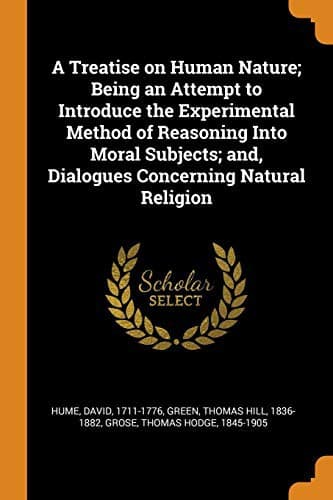
A Treatise of Human Nature: Being an Attempt to Introduce the Experimental Method Into Moral Subjects; and Dialogues Concerning Natural ReligionHume, David
PhilosophyPhilosophy
A Treatise of Human Nature: Being an Attempt to Introduce the Experimental Method Into Moral Subjects; and Dialogues Concerning Natural Religion
Hume, David
Emotions; Ethics; Knowledge, Theory of; Philosophy, English
45. The result of Locke’s statement, thus examined, clearly is that
real existence belongs to the present momentary act of consciousness,
and to that alone. Ascribed as it is to the ‘thing itself,’ to the
idea which, _as general_, has it not, and to the mixed mode, it is in
each case the momentary presence to consciousness that constitutes
it. To a thing itself, as distinct from the presentation to
consciousness, it cannot belong, for such a ‘thing’ means that which
remains identical with itself under manifold appearances, and both
identity and appearance imply relation, _i.e._ ‘an invention of the
mind.’ As little can it belong to the _content_ of any idea, since
this is in all cases constituted by relation to other ideas. Thus
if I judge ‘this is sweet,’ the real existence lies in the simple
‘this,’ in the mere form of presentation at an individual _now_,
not in the relation of this to other flavours which constitutes the
determinate sweetness, or to a sweetness at other times tasted.
If I judge ‘this is a horse,’ a present vision really exists, but
not so its relation to other sensations of sight or touch, closely
precedent or sequent, which make up the ‘total impression;’ much less
its relation to other like impressions thought of, in consideration
of which a common name is applied to it. If, again, I judge ‘this
is an act of justice,’ the present thought of the act, as present,
really exists; not so those relations of the act which either make
it just, or make me apply the name to it. It is true that according
to this doctrine the ‘really existent’ is the unmeaning, and that
any statement about it is impossible. We cannot judge of it without
bringing it into relation, in which it ceases to be what in its
mere singleness it is, and thus loses its reality, overlaid by the
‘invention of the understanding.’ Nay, if we say that it is the mere
‘this’ or ‘that,’ as such--the simple ‘here’ and ‘now’--the very
‘this,’ in being mentioned or judged of, becomes related to other
things which we have called ‘this,’ and the ‘now’ to other ‘nows.’
Thus each acquires a generality, and with it becomes fictitious.
As Plato long ago taught--though the lesson seems to require to
be taught anew to each generation of philosophers--a consistent
sensationalism must be speechless. Locke, himself, in one of the
passages quoted, implicitly admits this by indicating that only
through relations or in their generality are ideas ‘significant.’
How Locke avoids this result.
Public-domain text, read in full here on John Shaqi.
Reviews
Reviews
No reviews yet
Be the first to share your thoughts on this work.
Join the Discussion
Join the discussion
Sign in to leave a comment or review.
Sign InorCreate an account