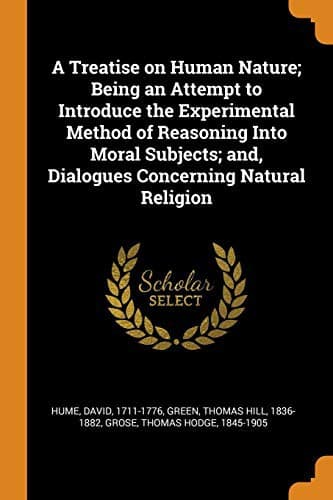
A Treatise of Human Nature: Being an Attempt to Introduce the Experimental Method Into Moral Subjects; and Dialogues Concerning Natural ReligionHume, David
PhilosophyPhilosophy
A Treatise of Human Nature: Being an Attempt to Introduce the Experimental Method Into Moral Subjects; and Dialogues Concerning Natural Religion
Hume, David
Emotions; Ethics; Knowledge, Theory of; Philosophy, English
ideas from other ideas that accompany them in real existence. ‘When
some one first lit on a parcel of that sort of substance we denote by
the word _gold_, ... its peculiar colour, perhaps, and weight were
the first he abstracted from it, to make the complex idea of that
species ... another perhaps added to these the ideas of fusibility
and fixedness ... another its ductility and solubility in aqua regia.
These, or part of these, put together, usually make the complex idea
in men’s minds of that sort of body we call _gold_.’ (Book II. chap.
xxxi. sec. 9.) Here the supposition is that a thing, multitudinously
qualified, is given apart from any action of the understanding,
which then proceeds to act in the way of successively detaching
(‘abstracting’) these qualities and recombining them as the idea of a
species. Such a recombination, indeed, would seem but wasted labour.
The qualities are assumed to be already found by the understanding
and found as in a thing; otherwise the understanding could not
abstract them from it. Why should it then painfully put together in
imperfect combination what has been previously given to it complete?
Of the complex idea which results from the work of abstraction,
nothing can be said but a small part of what is predicable of the
known thing which the possibility of such abstraction presupposes.
[1] ‘All impressions are perishing existences.’--Hume. See below,
paragraph 208.
This is the real thing from which abstraction is supposed to start.
48. ‘The complex idea of a species,’ spoken of in the passage last
quoted, corresponds to what, in Locke’s theory of substance, is
called the ‘idea of a particular sort of substance.’ In considering
that theory we saw that, according to his account, the beginning of
the process by which the ‘abstract idea of substance’ was formed,
was either that abstract idea itself, the mere ‘something,’ or by
a double contradiction the ‘complex idea of a particular sort of
substance’ which yet we only come to have _after_ the abstract idea
has been formed. In the passage now before us there is no direct
mention of the abstraction of the ‘substratum,’ as such, but only of
the quality, and hence there is no ambiguity about the paralogism. It
is not a mere ‘something’ that the man ‘lights upon,’ and thus it is
not this that holds the place at once of the given and the derived
but a something having manifold qualities to be abstracted. In other
words, it is the ‘idea of a particular sort of substance’ that he
starts from, and it is just this again to which as a ‘complex idea
of a species,’ his understanding is supposed gradually to lead him.
The understanding, indeed, according to Locke, is never adequate
to nature, and accordingly the qualities abstracted and recombined
in the complex idea always fall vastly short of the fulness of
those given in the real thing; or as he states it in terms of the
multiplication table (Book II. chap. xxxi. sec. 10), ‘some who have
Public-domain text, read in full here on John Shaqi.
Reviews
Reviews
No reviews yet
Be the first to share your thoughts on this work.
Elsewhere in the archive
Join the Discussion
Join the discussion
Sign in to leave a comment or review.
Sign InorCreate an account