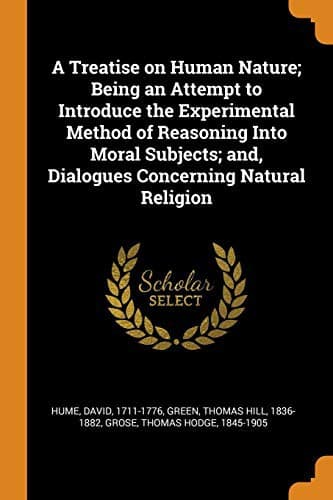
A Treatise of Human Nature: Being an Attempt to Introduce the Experimental Method Into Moral Subjects; and Dialogues Concerning Natural ReligionHume, David
PhilosophyPhilosophy
A Treatise of Human Nature: Being an Attempt to Introduce the Experimental Method Into Moral Subjects; and Dialogues Concerning Natural Religion
Hume, David
Emotions; Ethics; Knowledge, Theory of; Philosophy, English
51. We may get over the last difficulty, indeed, by distinguishing
between the complex and confused, between abstraction and analysis.
We may say that what is originally given in experience is the
confused, which to us is simple, or in other words has no definite
content, because, till it has been analysed, nothing can be said of
it, though in itself it is infinitely complex; that thus the process,
which Locke roughly calls abstraction, and which, as he describes
it, consists merely in taking grains from the big heap that is
given in order to make a little heap of one’s own, is yet, rightly
understood, the true process of knowledge--a process which may be
said at once to begin with the complex and to end with it, to take
from the concrete and to constitute it, because it begins with that
which is in itself the fulness of reality, but which only becomes so
for us as it is gradually spelt out by our analysis. To put the case
thus, however, is not to correct Locke’s statement, but wholly to
change his doctrine. It renders futile his easy method of ‘sending
a man to his senses’ for the discovery of reality, and destroys the
supposition that the elements of knowledge can be ascertained by the
interrogation of the individual consciousness. Such consciousness can
tell nothing of its own beginning, if of this beginning, as of the
purely indefinite, nothing can be said; if it only becomes defined
through relations, which in its state of primitive potentiality are
not actually in it. The senses again, so far from being, in that
mere passivity which Locke ascribes to them, organs of ready-made
reality, can have nothing to tell, if it is only through the active
processes of ‘discerning, comparing, and compounding,’ that they
acquire a definite content. But to admit this is nothing else than,
in order to avoid a contradiction of which Locke was not aware, to
efface just that characteristic of his doctrine which commends it to
‘common sense’--the supposition, namely, that the simple datum of
sense, as it is for sense or in its mere individuality, is the real,
in opposition to the ‘invention of the mind.’ That this supposition
is to make the real the unmeaning, the empty, of which nothing can be
said, he did not see because, under an unconscious delusion of words,
even while asserting that the names of simple ideas are undefinable
(Book III. chap. iv. sec. 4), which means that nothing can be said
of such ideas, and while admitting that the processes of discerning,
comparing, and compounding ideas, which mean nothing else than the
bringing them into relation [1] or the superinduction upon them of
fictions of the mind, are necessary to constitute even the beginnings
of knowledge, he yet allows himself to invest the simple idea, as
the real, with those definite qualities which can only accrue to
it, according to his showing, from the ‘inventive’ action of the
understanding.
Public-domain text, read in full here on John Shaqi.
Reviews
Reviews
No reviews yet
Be the first to share your thoughts on this work.
Elsewhere in the archive
Join the Discussion
Join the discussion
Sign in to leave a comment or review.
Sign InorCreate an account