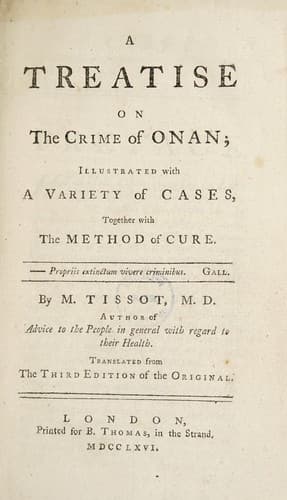
A Treatise on the Crime of Onan: Illustrated with a Variety of Cases, Together with the Method of CureTissot, S. A. D. (Samuel Auguste David)
Science
A Treatise on the Crime of Onan: Illustrated with a Variety of Cases, Together with the Method of Cure
Tissot, S. A. D. (Samuel Auguste David)
Masturbation -- Early works to 1800; Sexual ethics -- Early works to 1800
“that they should never be absolutely alone; that they should be kept
from giving themselves up to their own reflexions; that they should be
diverted or kept from reading, or any occupation of the mind; all these,
(as he observes,) being so many causes that exhaust the spirits and
retard the cure.” I should not, however, be for totally debarring them
from all reading. It might be enough to forbid their reading for too long
a time at once, if it were but on account of the weakness of their eyes;
or all reading that should require too much application, but especially
and severely any kind of reading that might recall to their mind ideas,
or to their imagination objects, of which it were to be wished they
should lose the remembrance: but there are subjects which, without much
fixing the attention, and without recalling dangerous images, might
agreeably divert, entertain, and prevent the terrible dangers of a
wearisome idleness.
_REMEDIES._
I shall follow the same order as in the preceding article. I shall point
out the pretended remedies, which are to be avoided, before I enter
on the mention of those which are the eligible ones. I have already
taken notice of a first class of those which should be excluded, the
irritating, the heating, the volatile medicines. There is a second one,
of a very opposite nature, and equally noxious, and that is evacuatives.
I have already observed, that sweats, an over-secretion of the _saliva_,
and too copious urines, exhausted the patient. I shall not then repeat
my premonition against those evacuations: it is consequentially clear
enough, that all the medicines which excite them, should be banished. It
remains then to examine the propriety of bleeding, and of the evacuations
of the _primæ viæ_. The curative indications being to restore strength,
now, in order to judge whether they are proper, it is but to know whether
they can be expected to answer that indication. I shall not be long
on this head. There are two cases in which bleeding restores strength;
in all others, it diminishes it. The first is, when there is too great
an abundance of blood; this is not the case in consumptions; or when
the blood has acquired an inflammatory inspissation, which, rendering
it unfit for its uses, quickly destroys the vital forces; this is the
disorder of the vigorous, of those who have rigid fibres, and a strong
circulation: our sick are in precisely the contrary case; bleeding then
cannot but be hurtful to them. “Every drop of blood, (according to M.
GILCHRIST,) is precious to persons in a consumption: the assimilating
power that repairs it being destroyed, they have not more than barely
sufficient to keep up the circulation, and that but a languid one[115].”
M. LOBB, who has very justly calculated the effects of evacuations, is
positive in this sense. He observes, “that in bodies, which have no more
than the necessary quantity of blood, if that is diminished by bleeding
Public-domain text, read in full here on John Shaqi.
Reviews
Reviews
No reviews yet
Be the first to share your thoughts on this work.
Elsewhere in the archive
Join the Discussion
Join the discussion
Sign in to leave a comment or review.
Sign InorCreate an account