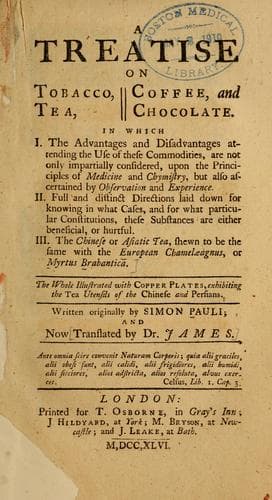
A Treatise on Tobacco, Tea, Coffee, and ChocolatePaulli, Simon
History
A Treatise on Tobacco, Tea, Coffee, and Chocolate
Paulli, Simon
Chocolate -- Early works to 1800; Coffee -- Early works to 1800; Tea -- Early works to 1800; Tobacco -- Early works to 1800
Pains, and Precautions observed by the _Chinese_, I doubt not but
it would be equal to, their _Tea_; for if the same Measures are not
taken in the Preparation of the same Herb, how is it possible, that it
should produce similar and uniform Effects, especially if the one is
gathered in the _Spring_, and the other in the End of the _Summer_:
The one artificially dried in the House, and the other dried in the
open Air by the Heat of the Sun; the one collected when it begins to
appear, and other when the Plant is full of a roscid, sulphureous Dew,
and bears Flowers, and Seeds. For this Reason, _Scherbius_ justly
observes, "That when many Things concur to the Production of the same
Effect; all these Things ought to be exactly the same." _Hoffman_, in
_Comment. Lib. 7._ represents this Doctrine in the following accurate
and beautiful Manner: "Individual Objects often appear to our Senses to
have no Difference; whereas, a very considerable one is observed in
their Effects. This Circumstance constitutes that Individuality, which
cannot be described, and which, I remember, _Scherbius_, my old Master,
used to illustrate by the following _Simile_: If a Bell-Founder should
make twenty small Bells, of the same Metal, in the same Mould, at the
same Time, and in the same Place; yet the Sound of no one of them will
be perfectly similar to that of another. What can be the Cause of this
Variation? The Artist, the Mould, the Metal, and the Fire, concur to
produce the same Effects, which, however, is not obtained. Besides,
if we were carefully to examine these Bells by the Sight, the Touch,
the Weight and other Circumstances, we can discover no Difference;
which, however, is sufficiently evinced by the Sound. Some Things, said
my Matter, can neither be described, nor expressed, and of this Kind
are these Differences. Perhaps, in this Case, there is not an equable
Thickness of the Metal, because the Fire has not equably pervaded all
its Particles. Perhaps the Surface is not every where smooth because
the fused Metal might have been in some Parts more refrigerated than
in others: and perhaps, there maybe other Variations; for, unless
all Circumstances exactly concur, the same Sound cannot be produced
in all the Bells." I have quoted this Passage from _Hoffman_, lest
any Person, observing some Differences between our _Chamelæagnus_,
and the _Chinese_, or _Tartars Tea_, should forthwith doubt,--whether
they are Shrubs of the same Species, as I have already proved them to
be. The _Chinese Tea_, therefore, and our _Chamelæagnus_, are Shrubs
of the same Species; though, for the former, we go beyond the _Cape
of Good Hope_, into _China_, cross the _Equator_ four Times in every
Voyage, and expose ourselves to uncommon Hardships and Dangers, in
order to bring Home the Leaves of an unknown Shrub, which has not the
same Virtues and Qualities for which the _Chinese Tea_ is celebrated
in _China_, and to which our _European Betony_ is preferable. Since,
Public-domain text, read in full here on John Shaqi.
Reviews
Reviews
No reviews yet
Be the first to share your thoughts on this work.
Elsewhere in the archive
Join the Discussion
Join the discussion
Sign in to leave a comment or review.
Sign InorCreate an account