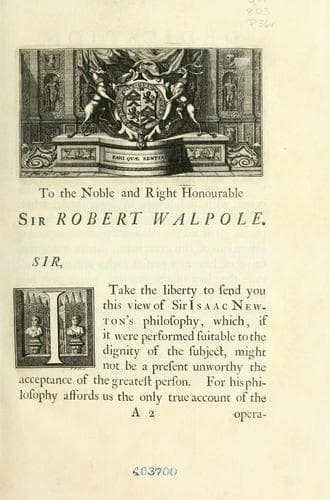
A View of Sir Isaac Newton's PhilosophyPemberton, Henry
Science
A View of Sir Isaac Newton's Philosophy
Pemberton, Henry
Newton, Isaac, 1642-1727. Principia
HAVING thus explained Sir ~ISAAC NEWTON’s~ method of reasoning
in philosophy, I shall now proceed to my intended account of his
discoveries. These are contained in two treatises. In one of them, the
MATHEMATICAL PRINCIPLES OF NATURAL PHILOSOPHY, his chief design is to
shew by what laws the heavenly motions are regulated; in the other,
his OPTICS, he discourses of the nature of light and colours, and of
the action between light and bodies. This second treatise is wholly
confined to the subject of light: except some conjectures proposed
at the end concerning other parts of nature, which lie hitherto more
concealed. In the other treatise our author was obliged to smooth the
way to his principal intention, by explaining many things of a more
general nature: for even some of the most simple properties of matter
were scarce well established at that time. We may therefore reduce Sir
~ISAAC NEWTON~’s doctrine under three general heads; and I
shall accordingly divide my account into three books. In the first I
shall speak of what he has delivered concerning the motion of bodies,
without regard to any particular system of matter; in the second I
shall treat of the heavenly motions; and the third shall be employed
upon light.
2. IN the first part of my design, we must begin with an account of the
general laws of motion.
3. THESE laws are some universal affections and properties of matter
drawn from experience, which are made use of as axioms and evident
principles in all our arguings upon the motion of bodies. For as it
is the custom of geometers to assume in their demonstrations some
propositions, without exhibiting the proof of them; so in philosophy,
all our reasoning must be built upon some properties of matter, first
admitted as principles whereon to argue. In geometry these axioms are
thus assumed, on account of their being so evident as to make any
proof in form needless. But in philosophy no properties of bodies can
be in this manner received for self-evident; since it has been observed
above, that we can conclude nothing concerning matter by any reasonings
upon its nature and essence, but that we owe all the knowledge, we
have thereof, to experience. Yet when our observations on matter have
inform’d us of some of its properties, we may securely reason upon them
in our farther inquiries into nature. And these laws of motion, of
which I am here to speak, are found so universally to belong to bodies,
that there is no motion known, which is not regulated by them. These
are by Sir ~ISAAC NEWTON~ reduced to three[43].
Public-domain text, read in full here on John Shaqi.
Reviews
Reviews
No reviews yet
Be the first to share your thoughts on this work.
Join the Discussion
Join the discussion
Sign in to leave a comment or review.
Sign InorCreate an account