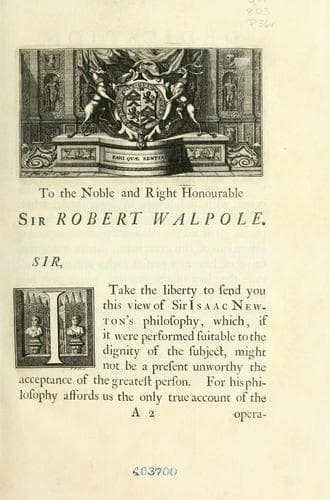
A View of Sir Isaac Newton's PhilosophyPemberton, Henry
Science
A View of Sir Isaac Newton's Philosophy
Pemberton, Henry
Newton, Isaac, 1642-1727. Principia
5. LET two equal bodies move against each other with equal swiftness.
Then the force, with which each of them presses forwards, being equal
when they strike; each pressing in its own direction with the same
energy, neither shall surmount the other, but both be stopt, if they
be not elastic: for if they be elastic, they shall from thence recover
new motion, and recede from each other, as swiftly as they met, if they
be perfectly elastic; but more slowly, if less so. In the same manner,
if two bodies of unequal bigness strike against each other, and their
velocities be so related, that the velocity of the lesser body shall
exceed the velocity of the greater in the same proportion, as the
greater body exceeds the lesser (for instance, if one body contains
twice the solid matter as the other, and moves but half as fast) two
such bodies will entirely suppress each other’s motion, and remain from
the time of their meeting fixed; if, as before, they are not elastic:
but, if they are so in the highest degree, they shall recede again,
each with the same velocity, wherewith they met. For this elastic
power, as in the preceding case, shall renew their motion, and pressing
equally upon both, shall give the same motion to both; that is, shall
cause the velocity, which the lesser body receives, to bear the same
proportion to the velocity, which the greater receives, as the greater
body bears to the lesser: so that the velocities shall bear the same
proportion to each other after the stroke, as before. Therefore if the
bodies, by being perfectly elastic, have the sum of their velocities
after the stroke equal to the sum of their velocities before the
stroke, each body after the stroke will receive its first velocity.
And the same proportion will hold likewise between the velocities,
wherewith they go off, though they are elastic but in a less degree;
only then the velocity of each will be less in proportion to the defect
of elasticity.
Public-domain text, read in full here on John Shaqi.
Reviews
Reviews
No reviews yet
Be the first to share your thoughts on this work.
Elsewhere in the archive
Join the Discussion
Join the discussion
Sign in to leave a comment or review.
Sign InorCreate an account