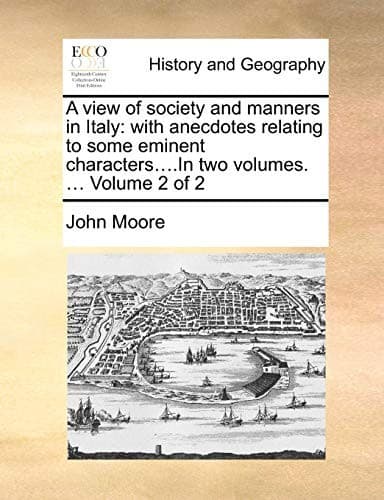
A View of Society and Manners in Italy, Volume 2 (of 2): With Anecdotes Relating to some Eminent CharactersMoore, John
History
A View of Society and Manners in Italy, Volume 2 (of 2): With Anecdotes Relating to some Eminent Characters
Moore, John
Italy -- Description and travel -- Early works to 1800; Italy -- Social life and customs -- Early works to 1800
The army of Hannibal is said to have been conquered by the luxuries of
this place; but the judicious Montesquieu observes, that the Carthaginian
army, enriched by so many victories, would have found a Capua wherever
they had gone. Whether Capua brought on the ruin of Hannibal or not,
there can be no doubt that Hannibal occasioned the ruin of Capua.
Having broken their connection with Rome, and formed an alliance with
her enemy, the Capuans were, in the course of the war, besieged by the
Consuls Fulvius and Appius. Hannibal exerted all his vast abilities
for the relief of his new friends; but was not able to bring the Roman
army to a battle, or to raise the siege. When every other expedient
had failed, he marched directly to Rome, in the hopes of drawing the
Roman army after him to defend the capital. A number of alarming events
conspired, at this time, to depress the spirit of the Roman Senate. The
Proconsul Sempronius Gracchus, who commanded an army in Lucania, had
fallen into an ambuscade, and was massacred. The two gallant brothers,
the Scipios, who were their generals in Spain, had been defeated and
killed; and Hannibal was at their gates. How did the Senate behave at
this crisis? Did they spend their time in idle harangues and mutual
accusations? Did they throw out reflections against those senators who
were against entering into a treaty with the Carthaginians till their
army should be withdrawn from Italy? Did they recall their army from
Capua? Did they shew any mark of despondence? In this slate of affairs,
the Roman Senate sent orders to Appius to continue the siege of Capua;
they ordered a reinforcement to their army in Spain; the troops for that
service marching out at one gate of Rome, while Hannibal threatened to
enter by storm at another. How could such a people fail to become the
masters of the world!
The country between Capua and Naples displays a varied scene of lavish
fertility, and with great propriety might be named Campania Felix, if
the richest and most generous soil, with the mildest and most agreeable
climate, were sufficient to render the inhabitants of a country happy.
[5] Anxur fuit quæ nunc Terracinæ sunt; urbs prona in paludes.
TIT. LIV. lib. iv.
LETTER LIV.
Naples.
The day after our arrival at this place, we waited on Sir W—— H——, his
Majesty’s minister at this court. He had gone early that morning on a
hunting party with the King; but the Portuguese ambassador, at L——y H——’s
desire, undertook to accompany the D—— on the usual round of visits;
Sir W—— was not expected to return for several days, and the laws of
etiquette do not allow that important tour to be delayed so long. As we
have been continually driving about ever since our arrival, I am already
pretty well acquainted with this town, and the environs.
Public-domain text, read in full here on John Shaqi.
Reviews
Reviews
No reviews yet
Be the first to share your thoughts on this work.
Join the Discussion
Join the discussion
Sign in to leave a comment or review.
Sign InorCreate an account