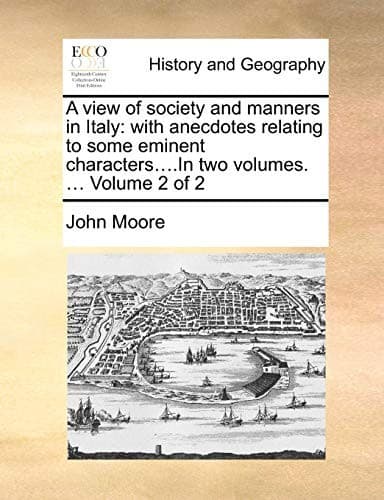
A View of Society and Manners in Italy, Volume 2 (of 2): With Anecdotes Relating to some Eminent CharactersMoore, John
History
A View of Society and Manners in Italy, Volume 2 (of 2): With Anecdotes Relating to some Eminent Characters
Moore, John
Italy -- Description and travel -- Early works to 1800; Italy -- Social life and customs -- Early works to 1800
It is the mode here, to have two running footmen, very gaily dressed,
before the carriage, and three or four servants in rich liveries behind;
these attendants are generally the handsomest young men that can be
procured. The ladies or gentlemen within the coaches, glitter in all the
brilliancy of lace, embroidery, and jewels. The Neapolitan carriages,
for gala days, are made on purpose, with very large windows, that the
spectators may enjoy a full view of the parties within. Nothing can be
more showy than the harness of the horses; their heads and manes are
ornamented with the rarest plumage, and their tails set off with riband
and artificial flowers, in such a graceful manner that you are apt to
think they have been adorned by the same hands that dressed the heads of
the ladies, and not by common grooms.
After all, you will perhaps imagine the amusement cannot be very great.
The carriages follow each other in two lines, moving in opposite
directions. The company within smile, and bow, and wave the hand, as they
pass and repass their acquaintance; and doubtless imagine, that they are
the most important figures in the procession. The horses, however, seem
to be quite of a different way of thinking, and to consider themselves
as the chief objects of admiration, looking on the livery servants, the
volantis, the lords, and the ladies, as their natural suit on all such
solemn occasions.
LETTER LVI.
Naples.
The greatest part of kings, whatever may be thought of them after their
death, have the good fortune to be represented, at some period of their
lives, generally at the beginning of their reigns, as the greatest
and most virtuous of mankind. They are never compared to characters
of less dignity than Solomon, Alexander, Cæsar, or Titus; and the
comparison usually concludes to the advantage of the living monarch. They
differ in this, as in many other particulars, from those of the most
distinguished genius and exalted merit among their subjects, That the
fame of the latter, if any awaits them, seldom arrives at its meridian
till many years after their death; whereas the glory of the former is
at its fullest splendour during their lives; and most of them have the
satisfaction of hearing all their praises with their own ears. Each
particular monarch, taken separately, is, or has been, considered as a
star of great lustre; yet any number of them, taken without selection,
and placed in the historical galaxy, add little to its brightness, and
are often contemplated with disgust. When we have occasion to mention
kings in general, the expression certainly does not awaken a recollection
of the most amiable or most deserving part of the human species; and
tyranny in no country is pushed so far, as to constrain men to speak of
them, when we speak in general terms, as if they were. It would revolt
the feelings, and rouse the indignation, even of slaves. Full freedom
Public-domain text, read in full here on John Shaqi.
Reviews
Reviews
No reviews yet
Be the first to share your thoughts on this work.
Elsewhere in the archive
Join the Discussion
Join the discussion
Sign in to leave a comment or review.
Sign InorCreate an account