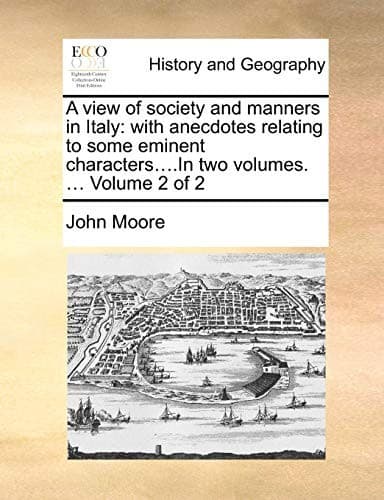
A View of Society and Manners in Italy, Volume 2 (of 2): With Anecdotes Relating to some Eminent CharactersMoore, John
History
A View of Society and Manners in Italy, Volume 2 (of 2): With Anecdotes Relating to some Eminent Characters
Moore, John
Italy -- Description and travel -- Early works to 1800; Italy -- Social life and customs -- Early works to 1800
It is imagined that the cabinet of this Court is entirely guided by
that of Spain; which, on its part, is thought to be greatly under the
influence of French counsels. The manners, as well as the politics, of
France, are said to prevail at present at the Court of Madrid. I do not
presume to say of what nature the politics of his Neapolitan Majesty
are, or whether he is fond of French counsels or not; but no true-born
Englishman existing can shew a more perfect contempt of their manners
than he does. In domestic life, this Prince is generally allowed to be
an easy master, a good-natured husband, a dutiful son, and an indulgent
father.
The Queen of Naples is a beautiful woman, and seems to possess the
affability, good-humour, and benevolence, which distinguish, in such an
amiable manner, the Austrian family.
LETTER LVII.
Naples.
The hereditary jurisdiction of the nobles over their vassals subsists,
both in the kingdom of Naples and Sicily, in the full rigour of the
feudal government. The peasants therefore are poor; and it depends
entirely on the personal character of the masters, whether their poverty
is not the least of their grievances. If the land was leased out to
free farmers, whose property was perfectly secure, and the leases of
a sufficient length to allow the tenant to reap the fruits of his own
improvements, there is no manner of doubt that the estates of the
nobility would produce much more. The landlord might have a higher rent
paid in money, instead of being collected in kind, which subjects him to
the salaries and impositions of a numerous train of stewards; and the
tenants, on their parts, would be enabled to live much more comfortably,
and to lay up, every year, a small pittance for their families. But the
love of domineering is so predominant in the breasts of men who have been
accustomed to it from their infancy, that, if the alternative were in
their choice, many of them would rather submit to be themselves slaves to
the caprices of an absolute prince, than become perfectly independent, on
the condition of giving independence to their vassals. There is reason
to believe that this ungenerous spirit prevails pretty universally among
the nobility all over Europe. The German Barons are more shocked at the
idea of their peasants becoming perfectly free, like the farmers of Great
Britain, than they are solicitous to limit the power of their princes:
And, from the sentiments I have heard expressed by the French, I very
much doubt, whether their high nobility would accept of the privileges
of English peers, at the expence of that insolent superiority, and those
licentious freedoms, with which _they_ may, though no English peer can,
treat with impunity the citizens and people of inferior rank. We need be
the less surprised at this, when we consider that, in some parts of the
British empire, where the equable and generous laws of England prevail,
Public-domain text, read in full here on John Shaqi.
Reviews
Reviews
No reviews yet
Be the first to share your thoughts on this work.
Elsewhere in the archive
Join the Discussion
Join the discussion
Sign in to leave a comment or review.
Sign InorCreate an account