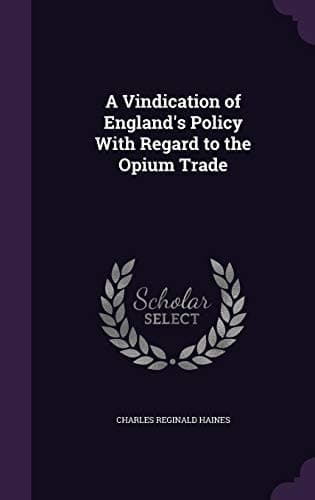
A Vindication of England's Policy with Regard to the Opium TradeHaines, Charles Reginald
History
A Vindication of England's Policy with Regard to the Opium Trade
Haines, Charles Reginald
Opium trade
We may here briefly notice[133] Li Hung Chang's latest proposal, that he
should farm or purchase the monopoly of all the Indian opium; with the
intention, he would no doubt himself say, of getting the control of the
trade into his own hands, and limiting the import, just as on a previous
occasion, in a communication to the Anglo-Opium Society, he asserted that
the only object of the Chinese authorities in taxing opium was in the
past, as it would be in the future, the desire to repress the traffic.
Considering, then, the sudden abolition of the opium traffic as
practically out of the question, and leaving out of sight the undoubtedly
possible, though not likely, gradual cessation of the trade between India
and China owing to the competition of the native drug, it only remains for
us to propose some practical solution of the difficulty, some less heroic
method of removing this rock of offence that has so divided the current of
English feeling. If we reject the total suppression theory, there are, as
it seems, two alternatives, and two only, left to us. We may on the one
hand follow the sensible and statesman-like recommendation of Sir
Rutherford Alcock in 1869. With a view to test the sincerity of the
Chinese Government, and their power to prohibit the growth of the poppy in
their own dominions, that experienced Minister proposed, in a Convention
which the Chinese seem disposed to ratify, that they should receive an
increased duty on opium imported, "and moreover be allowed to test their
power and will to limit or diminish the hitherto unchecked production of
opium in their own provinces by an understanding with the Indian
Government during a certain period not to extend the production in India;
and if the Chinese Government kept faith and showed the power greatly to
diminish, and more or less rapidly stop, the culture of the poppy
altogether, the Indian Government would then, _pari passu_, consider how
far they could further co-operate by diminishing their own area of
culture, having time to substitute other crops and industries to take its
place."
Public-domain text, read in full here on John Shaqi.
Reviews
Reviews
No reviews yet
Be the first to share your thoughts on this work.
Join the Discussion
Join the discussion
Sign in to leave a comment or review.
Sign InorCreate an account