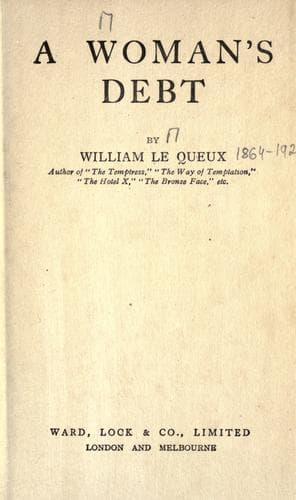
Detective and mystery stories; England -- Social life and customs -- 20th century -- Fiction; English fiction -- 20th century
“Of course I can’t prove it in a way that might satisfy you, but I
do know that I have never told anybody else. There is of course the
maker,” he added sarcastically. “Perhaps you are including him in your
calculations.”
“I think I will consent readily to his elimination,” replied Lane in
his quiet, not unhumorous way. “Now, Mr. Morrice, we will discuss this
matter without heat. I am now employed by you as well as Mr. Croxton,
and I have only one object in view. But I must conduct my investigation
in my own way, and I want to go a little deeper than we have yet gone.”
Morrice was impressed by the grave authoritative manner of the man;
he showed a strong touch of that quality which we notice in eminent
judges, successful barristers and all properly qualified members of
the legal profession, a patient pursuit of facts, a strongly developed
power of deduction from whatever facts are presented, a keen faculty of
analysis.
“Now, Mr. Morrice, I shall ask you a question or two for my own
enlightenment. From the little you have explained to me, the mechanism
of this safe is extremely complicated. Did you and Mr. Croxton carry
all the details of it in your heads, or had you some written memorandum
of its working to refer to in case of a temporary lapse of memory?”
Morrice was quick enough immediately to see the drift of that question,
and his manner changed at once. “Thank you for that suggestion, Mr.
Lane; I fear I have shown a little impatience. For all practical
purposes, we did carry it in our heads, but I have in my possession,
as you surmise, a written key to which reference could be made in the
event of our requiring an elaborate combination.”
“And that key is still in your possession?”
“Yes. I keep it in the safe in my dressing-room. I looked this morning,
and it was there.”
The detective ruminated over this latest piece of information. While he
was doing so, Morrice spoke again, with just a little hesitation, as
if he knew that what he was going to say would cut the ground a little
from under his strongly expressed theory of Croxton’s guilt.
“You ought to know the whole truth, Mr. Lane, and you shall have it
for what it is worth. This present memorandum—I will speak of it by
that name—is one that I wrote out from memory. I had an original one,
perhaps just a trifle fuller, but I lost it, that is to say I could not
find it amongst my papers, some two years ago.”
Still clinging obstinately to his theory, he added a few comments
which, needless to say, did not make much impression on his listener,
who went into possibilities and probabilities perhaps just a trifle too
elaborately for the ordinary man.
“You know how easily papers get lost or mislaid. It is as likely as
not that the original memorandum will turn up in the last place I
should expect to find it. And if it got loose and was swept up by some
careless servant, it would get into the hands of the dustman. To the
ordinary person it would, of course, be quite unintelligible.”
Public-domain text, read in full here on John Shaqi.
Reviews
Reviews
No reviews yet
Be the first to share your thoughts on this work.
Join the Discussion
Join the discussion
Sign in to leave a comment or review.
Sign InorCreate an account