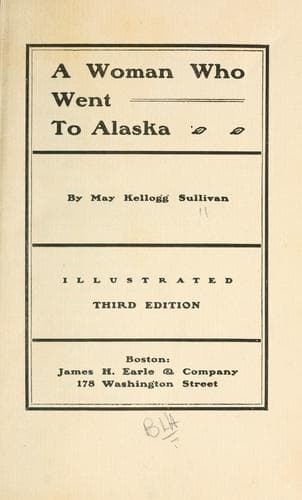
Alaska -- Description and travel; Frontier and pioneer life -- Alaska
Of the good influence going out through the rough mining camp during the
long and dreary winter from the home of these sweet and Christian women,
no account has probably ever been kept, except by the recording angel,
who never forgets.
The day after we landed at Nome I secured work. Not, however, to begin
immediately, which pleased me well, as I should then have a little time
to look for father, inspect the camp, study conditions and take notes
and kodak views.
"Can you cook for a gang of men?" asked Mr. A. kindly smiling down at me
when I had stopped him on the street and asked for work in his camp for
the English girl and myself, as we wished to be together.
"Indeed, I can. I will do my very best, Mr. A., and I feel sure we can
please you. My friend is an extra good cook, as you will discover if you
give us work. Will you try us?"
"I will," he replied.
"At what wages, please?"
"Five dollars per day, each, with board," promptly answered the
gentleman whose two gold claims on famous Anvil Creek made him one of
the richest men in Alaska.
So it was settled. Claim number nine, Anvil, was about seven miles from
Nome, and one of the most noted claims in the district. Mr. A., a former
Swedish missionary at Golovin Bay, had, with his doctor brother, voyaged
to Nome on the "St. Paul" when we did, so we already had a slight
acquaintance with both gentlemen and were pleased to get the work.
Anvil Creek claims had been worked the summer before. Gold had first
been discovered in the fall of 1898 by Mr. Hultberg, a Swedish
missionary, who learned of the precious metal around Nome from the
Eskimos. His mission was stationed at Golovin Bay, and he notified the
Swedes, Brynteson, Hagalin, Lindbloom and Linderberg, who in turn saw G.
W. Price and induced him to go with them, as he was the only one there
experienced in mining. Price was on his way to Kodiak over the ice by
dog-team en route to California, as the representative of C. D. Lane,
the San Francisco mining man and millionaire.
The most of Anvil Creek was staked by this party before they returned to
the mines at Council City, fifty miles up Fish River from Golovin Bay.
"On July second, 1899, a second cleanup was made on number one above
Discovery Claim, Anvil Creek, the property of J. Linderberg. The result
of four men shovelling out of the creek bed from a cut five feet to
bedrock for twenty hours amounted to fourteen thousand dollars in gold
dust. The men shovelled all the gravel from the moss down to bedrock
into the sluice box as it was all pay gravel. The owner refused five
hundred thousand dollars for the property without considering the
offer."
Tierney is authority for the statement that this claim produced four
hundred thousand dollars that season.
Public-domain text, read in full here on John Shaqi.
Reviews
Reviews
No reviews yet
Be the first to share your thoughts on this work.
Elsewhere in the archive
Join the Discussion
Join the discussion
Sign in to leave a comment or review.
Sign InorCreate an account