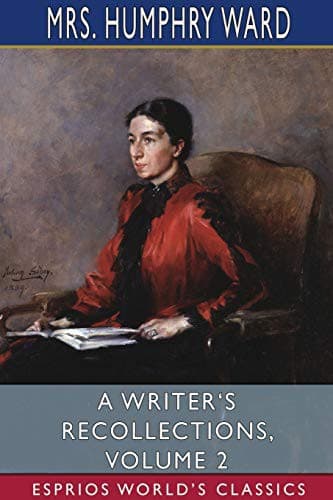
A Writer's Recollections — Volume 2Ward, Humphry, Mrs.
General
A Writer's Recollections — Volume 2
Ward, Humphry, Mrs.
Novelists, English -- 19th century -- Biography; Novelists, English -- 20th century -- Biography; Ward, Humphry, Mrs., 1851-1920
For the New Brotherhood of _Robert Elsmere_ had become in some sort a
realized dream; so far as any dream can ever take to itself the
practical garments of this puzzling world. To show that the faith of
Green and Martineau and Stopford Brooke was a faith that would wear and
work--to provide a home for the new learning of a New Reformation, and a
practical outlet for its enthusiasm of humanity--were the chief aims in
the minds of those of us who in 1890 founded the University Hall
Settlement in London. I look back now with emotion on that astonishing
experiment. The scheme had taken shape in my mind during the summer of
1889, and in the following year I was able to persuade Doctor Martineau,
Mr. Stopford Brooke, my old friend Lord Carlisle, and a group of other
religious Liberals, to take part in its realization. We held a crowded
meeting in London, and an adequate subscription list was raised without
difficulty. University Hall in Gordon Square was taken as a residence
for young men, and was very soon filled. Continuous teaching by the best
men available, from all the churches, on the history and philosophy of
religion, was one half the scheme; the other half busied itself with an
attempt to bring about some real contact between brain and manual
workers. We took a little dingy hall in Marchmont Street, where the
residents of the Hall started clubs and classes, Saturday mornings, for
children and the like. The foundation of Toynbee Hall--the Universities
Settlement--in East London, in memory of Arnold Toynbee, was then a
fresh and striking fact in social history. A spirit of fraternization
was in the air, an ardent wish to break down the local and geographical
barriers that separated rich from poor, East End from West End. The new
venture in which I was interested attached itself, therefore, to a
growing movement. The work in Marchmont Street grew and prospered. Men
and women of the working class found in it a real center of comradeship,
and the residents at the Hall in Gordon Square, led by a remarkable man
of deeply religious temper and Quaker origin, the late Mr. Alfred
Robinson, devoted themselves in the evenings to a work marked by a very
genuine and practical enthusiasm.
Public-domain text, read in full here on John Shaqi.
Reviews
Reviews
No reviews yet
Be the first to share your thoughts on this work.
Elsewhere in the archive
Join the Discussion
Join the discussion
Sign in to leave a comment or review.
Sign InorCreate an account