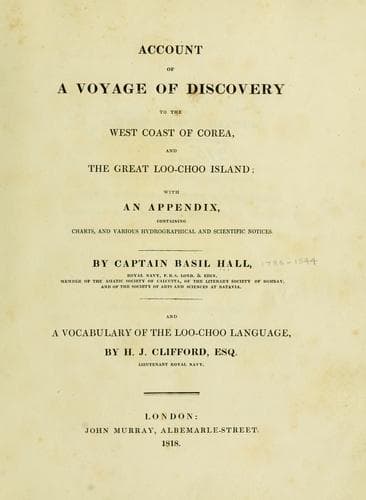
Account of a voyage of discovery to the west coast of Corea, and the great Loo-Choo IslandHall, Basil
History
Account of a voyage of discovery to the west coast of Corea, and the great Loo-Choo Island
Hall, Basil
Korea -- Description and travel; Ryukyu Islands -- Description and travel
The rock here rises in perpendicular rugged cliffs of coral, with a
number of rude square excavations on its face, which, at first sight,
appear to have been worn by the elements, but on examination shew
evident traces of art. Most of these caves are closed up by a wall of
loose stones, but in one, of which the mouth was open, several human
bones were found lying amongst the sand. On removing a stone from a
closed cave, a vase was observed in the inside, of an elegant shape; the
people signified to us that these were the remains of the dead, but we
did not make out distinctly whether the bones or the ashes only were
thus preserved. They made no objections to our examining these caves,
though they certainly were not pleased with it. No notice was taken of
what Captain Maxwell and I did; but Mr. Clifford, who had remained below
collecting words from some intelligent natives, was strongly recommended
by Ookooma to go back to the boat; he walked up, however, without
opposition, to the cave which we had been examining, and they ceased to
importune him. A number of little boys who had observed us occasionally
pulling flowers and plants, ran about collecting for us, and after
presenting what they had gathered, with much politeness, ran away
laughing with an arch expression of ridicule at our curiosity.
On our way back, instead of going directly off to the ships, we coasted
along shore in our boats, which gave us a new view of a stone bridge, of
one arch, connecting two parts of the town. On the south side of the
bridge we passed a space of considerable extent, probably set apart as a
burying ground. We saw here a number of large horse-shoe tombs like
those used in China, whitewashed, and apparently kept in good repair.
Most of the tombs, however, are in the form of small square houses, with
low pyramidal roofs; some of these were tiled, others thatched. It is
evident that, in what relates to the dead, they follow, in some
respects, the Chinese customs.
[Illustration: NAPAKIANG.]
The whole coast at this place is of coral cliffs, the base of which
appears to have been scooped out by the action of the sea. As this
excavation is at some places higher than the waves of the sea can be
supposed to have ever reached, there is difficulty in assigning the sea
as the cause; yet the roof of the excavation is horizontal for a great
extent, and its appearance, in every other respect, suggests that it has
been formed by the dashing of the waves. There is, moreover, some
difficulty in accounting for coral cliffs being so much above the level
of the sea, in which, according to every supposition, they must have
been formed.
Public-domain text, read in full here on John Shaqi.
Reviews
Reviews
No reviews yet
Be the first to share your thoughts on this work.
Join the Discussion
Join the discussion
Sign in to leave a comment or review.
Sign InorCreate an account