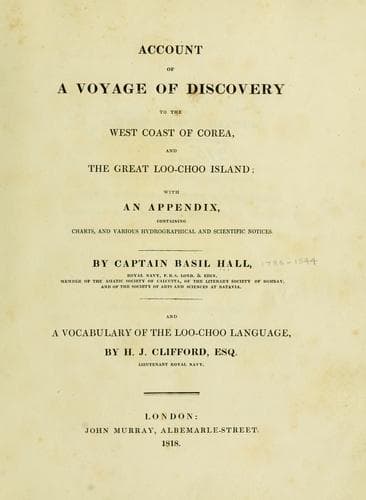
Account of a voyage of discovery to the west coast of Corea, and the great Loo-Choo IslandHall, Basil
History
Account of a voyage of discovery to the west coast of Corea, and the great Loo-Choo Island
Hall, Basil
Korea -- Description and travel; Ryukyu Islands -- Description and travel
The chiefs have dresses adapted to the state of the weather; yesterday
being cold and threatening, they all came on board with a sort of cloak
or great coat made of a thick blue stuff like woollen cloth, buttoned in
front. It is tighter than the ordinary dress, and is worn over it. It is
only in fine weather, and on state occasions, that they wear the band
turban, called by them "hatchee matchee;" at all other times they go
uncovered, having their hair dressed like the rest of the people.
20th of September.--The mercury in the barometer fell last night from
29. 72, to 29. 51, and the sky assumed a yellow appearance. We expected
a heavy gale, more particularly as it was so near the equinox, but we
were so sheltered by the land, that though it appeared to blow hard at
sea, we felt nothing of it where we lay.
Three or four canoes came round the south-west point of land this
forenoon; the people in them were supposed to have come from the other
side of the island, for they did not appear to have seen the ships
before. One of these people was much delighted with a looking-glass
which was shewn to him; he took it in his hands, and calling his
companions about him, shewed them in turn its effect. Having done so
several times, he held it opposite to his own face for four or five
minutes without altering his countenance in the least; at last he
smiled, and immediately and involuntarily nodded assent to the image in
the glass, which had so exactly expressed what he felt himself; he
seemed, however, aware, that it was a reflection of his own countenance,
as he pointed to himself, yet he could not restrain his curiosity from
looking behind, but instantly turned it round again. While the glass was
in his hands, he made us several long speeches, in which he frequently
repeated the word "Kagung," the Loo-choo name for mirror; but, from his
behaviour, it is probable he knew it only by name. One of this party
sold his "Jeewa" or head ornaments for a wine glass. Sometime
afterwards, the others saw a bottle, which they wished to purchase in
the same way; it was, however, given to them as a present, and they went
away very well satisfied. These canoes were of pine, from twelve to
twenty feet long, and from two to four wide; their anchor is made of
wood loaded with stones.
Public-domain text, read in full here on John Shaqi.
Reviews
Reviews
No reviews yet
Be the first to share your thoughts on this work.
Join the Discussion
Join the discussion
Sign in to leave a comment or review.
Sign InorCreate an account