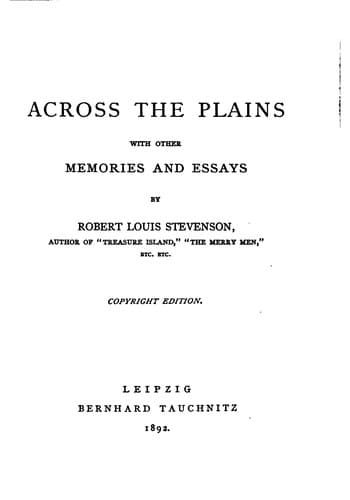
Across the Plains, with Other Memories and EssaysStevenson, Robert Louis
General
Across the Plains, with Other Memories and Essays
Stevenson, Robert Louis
Essays; Monterey (Calif.) -- Description and travel; West (U.S.) -- Description and travel
This singular society is purely
French, a creature of French virtues, and possibly of French defects. It
cannot be imitated by the English. The roughness, the impatience, the
more obvious selfishness, and even the more ardent friendships of the
Anglo-Saxon, speedily dismember such a commonwealth. But this random
gathering of young French painters, with neither apparatus nor parade of
government, yet kept the life of the place upon a certain footing,
insensibly imposed their etiquette upon the docile, and by caustic speech
enforced their edicts against the unwelcome. To think of it is to wonder
the more at the strange failure of their race upon the larger theatre.
This inbred civility—to use the word in its completest meaning—this
natural and facile adjustment of contending liberties, seems all that is
required to make a governable nation and a just and prosperous country.
Our society, thus purged and guarded, was full of high spirits, of
laughter, and of the initiative of youth. The few elder men who joined
us were still young at heart, and took the key from their companions. We
returned from long stations in the fortifying air, our blood renewed by
the sunshine, our spirits refreshed by the silence of the forest; the
Babel of loud voices sounded good; we fell to eat and play like the
natural man; and in the high inn chamber, panelled with indifferent
pictures and lit by candles guttering in the night air, the talk and
laughter sounded far into the night. It was a good place and a good life
for any naturally-minded youth; better yet for the student of painting,
and perhaps best of all for the student of letters. He, too, was
saturated in this atmosphere of style; he was shut out from the
disturbing currents of the world, he might forget that there existed
other and more pressing interests than that of art. But, in such a
place, it was hardly possible to write; he could not drug his conscience,
like the painter, by the production of listless studies; he saw himself
idle among many who were apparently, and some who were really, employed;
and what with the impulse of increasing health and the continual
provocation of romantic scenes, he became tormented with the desire to
work. He enjoyed a strenuous idleness full of visions, hearty meals,
long, sweltering walks, mirth among companions; and still floating like
music through his brain, foresights of great works that Shakespeare might
be proud to have conceived, headless epics, glorious torsos of dramas,
and words that were alive with import. So in youth, like Moses from the
mountain, we have sights of that House Beautiful of art which we shall
never enter. They are dreams and unsubstantial; visions of style that
repose upon no base of human meaning; the last heart-throbs of that
excited amateur who has to die in all of us before the artist can be
born. But they come to us in such a rainbow of glory that all subsequent
achievement appears dull and earthly in comparison.
Public-domain text, read in full here on John Shaqi.
Reviews
Reviews
No reviews yet
Be the first to share your thoughts on this work.
Elsewhere in the archive
Join the Discussion
Join the discussion
Sign in to leave a comment or review.
Sign InorCreate an account