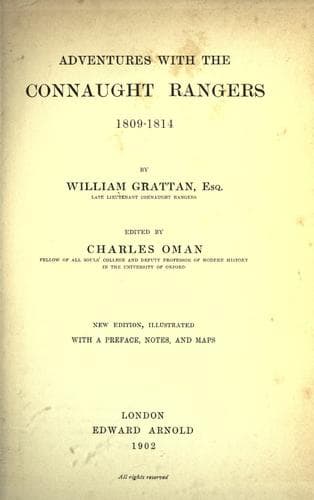
Adventures with the Connaught Rangers, 1809-1814Grattan, William
History
Adventures with the Connaught Rangers, 1809-1814
Grattan, William
Great Britain. Army. Regiment of Foot, 88th (Connaught Rangers); Peninsular War, 1807-1814 -- Personal narratives
The moment our troops had completely routed a body of the enemy’s
infantry, strewing the ground with dead and wounded, disorganised a park
of artillery, or unhorsed some squadrons of dragoons, _then_, and _then_
only, would these _gallant fellows_ sally forth from their lurking
places, and (first taking the precaution to put a stop to any sort of
parley from their unfortunate victims by knocking them on the head)
completely rifle them of everything they possessed. On the contrary, if
our troops met with any reverse, as in the case of Don Julian Sanchez
and his ragged band, our allies would take advantage of every incident
of ground, and make one of their rapid retrograde movements, sufficient
to baffle the evolutions of the most redoubtable _legère_ regiments in
the French army. This I say is the true harassing system, and the one
suited to the genius of the Peninsular nations. It weakens your enemy,
and is attended with no risk to yourselves or your friends, which is the
same thing; but in England many think that the Portuguese and Spaniards
did as much, if not more, during the Peninsular contest than the British
army.
Matters remained tranquil in our neighbourhood after the battle of
Fuentes d'Oñoro, and the retreat of the army of Portugal across the
Agueda, and Lord Wellington employed himself in giving directions for
the repairs of the injury inflicted by Brennier upon Almeida previous to
his evacuation of that fortress. The troops had recovered from their
fatigues and were fresh again and ready for anything, when accounts
reached us from the Alemtejo that General Beresford was carrying on the
siege of Badajoz, in which operation he was likely to be disturbed by
Marshal Soult, who was on his march from Seville. Our division broke up
from its cantonments on the 16th of May, and Lord Wellington, who rode
at a rapid pace, reached Elvas in three days. There he received the
report of the battle of Albuera.
The weather was fine and we continued our route without any forced
marches, taking the old beaten track through Castello Branco, Niza, and
Portalegre. Our march was uninterrupted by any particular incident; we
had no enemy near us, and were therefore left to ourselves.
Public-domain text, read in full here on John Shaqi.
Reviews
Reviews
No reviews yet
Be the first to share your thoughts on this work.
Elsewhere in the archive
Join the Discussion
Join the discussion
Sign in to leave a comment or review.
Sign InorCreate an account