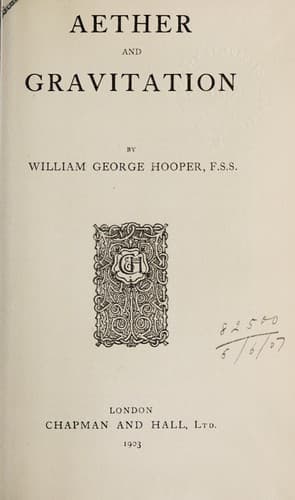
Ether (Space); Force and energy; Gravitation; Matter
As Young points out in his First Hypothesis,[6] the Aether possesses
this property of elasticity, but with the advance of scientific
knowledge and research, the elasticity of the Aether may be said to have
passed out of the hypothetical stage, into the state of actual fact and
experiment. Both McCullagh and Fresnel have assumed this property of
elasticity for the aetherial medium in order to account for certain
phenomena of light.
Apart, however, from the atomicity of the Aether, it is exceedingly
difficult to understand how such a property can belong to it. Atoms are
exceedingly small particles, possessing the property of elasticity, or
the power to recover their original shape after distortion or change of
shape. If the Aether therefore be atomic, as is pointed out in Art. 44,
it can at once be readily understood how the Aether as a whole can
possess the property of elasticity. The atoms of the Aether must be
inconceivably small, as the light-waves travel with the enormous
velocity of 186,000 miles per second.
What must therefore be the atomic vibration which such a statement
implies? If, on the other hand, the Aether is assumed to be continuous
and non-atomic, it must be seen how exceedingly difficult it is to
account for the elasticity of the Aether, as it seems absolutely
impossible for a medium which is continuous, and non-atomic, to be able
to transmit the waves of light with a finite velocity.
Apart, therefore, from atomicity of some kind or other, elasticity of
the Aether is an assumption philosophically incorrect, as it is contrary
to that simplicity of conception laid down by Newton, and is also
contrary to all experience, and thus violates the second Rule of
Philosophy.
Aether therefore must be said to be perfectly elastic; so perfectly
elastic, that it is susceptible to the least touch of any natural thing,
so that even an atom, so small that it cannot be seen with the most
powerful microscope, yet so elastic is this Aether medium, that the
least motion or vibration of one of these atoms, though the motion did
not exceed the 20- or 40-millionth part of an inch, yet even this would
create in the aetherial ocean, Aether-waves, just as a body moving in
water creates water-waves, which, radiating from the place of their
birth, beget and create others, the process continuing until they reach
the margin of the water in which they were generated. It is precisely
so with these Aether-waves, when once generated and set in motion. They
create others, the process being continued and perpetuated; and, unless
arrested in their course, may continue until they reach the very limits
and confines of material immensity and space.
Public-domain text, read in full here on John Shaqi.
Reviews
Reviews
No reviews yet
Be the first to share your thoughts on this work.
Elsewhere in the archive
Join the Discussion
Join the discussion
Sign in to leave a comment or review.
Sign InorCreate an account