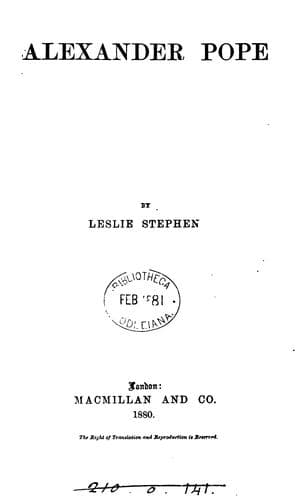
Poets, English -- 18th century -- Biography; Pope, Alexander, 1688-1744
He is forced to leave his jovial friends and
his worrying publishers "for Homer (damn him!) calls." He is, so he
assures us,
Still idle, with a busy air
Deep whimsies to contrive;
The gayest valetudinaire,
Most thinking rake alive.
And he takes a sad leave of London pleasures.
Luxurious lobster nights, farewell,
For sober, studious days!
And Burlington's delicious meal
For salads, tarts, and pease.
Writing from Bath a little earlier, to Teresa and Martha Blount, he
employs the same jaunty strain. "Every one," he says, "values Mr. Pope,
but every one for a different reason. One for his adherence to the
Catholic faith, another for his neglect of Popish superstition; one for
his good behaviour, another for his whimsicalities; Mr. Titcomb for his
pretty atheistical jests; Mr. Caryll for his moral and Christian
sentences; Mrs. Teresa for his reflections on Mrs. Patty; Mrs. Patty for
his reflections on Mrs. Teresa." He is an "agreeable rattle;" the
accomplished rake, drinking with the wits, though above boozing with the
squire, and capable of alleging his drunkenness as an excuse for writing
very questionable letters to ladies.
Pope was too sickly and too serious to indulge long in such youthful
fopperies. He had no fund of high spirits to draw upon, and his
playfulness was too near deadly earnest for the comedy of common life.
He had too much intellect to be a mere fribble, and had not the strong
animal passions of the thorough debauchee. Age came upon him rapidly,
and he had sown his wild oats, such as they were, while still a young
man. Meanwhile his reputation and his circle of acquaintances were
rapidly spreading, and in spite of all his disqualifications for the
coarser forms of conviviality, he took the keenest possible interest in
the life that went on around him. A satirist may not be a pleasant
companion, but he must frequent society; he must be on the watch for his
natural prey; he must describe the gossip of the day, for it is the raw
material from which he spins his finished fabric. Pope, as his writings
show, was an eager recipient of all current rumours, whether they
affected his aristocratic friends or the humble denizens of Grub Street.
Fully to elucidate his poems, a commentator requires to have at his
finger's ends the whole _chronique scandaleuse_ of the day. With such
tastes, it was natural that, as the subscriptions for his Homer began to
pour in, he should be anxious to move nearer the great social centre.
London itself might be too exciting for his health and too destructive
of literary leisure. Accordingly, in 1716, the little property at
Binfield was sold, and the Pope family moved to Mawson's New Buildings,
on the bank of the river at Chiswick, and "under the wing of my Lord
Burlington." He seems to have been a little ashamed of the residence;
the name of it is certainly neither aristocratic nor poetical. Two years
Public-domain text, read in full here on John Shaqi.
Reviews
Reviews
No reviews yet
Be the first to share your thoughts on this work.
Elsewhere in the archive
Join the Discussion
Join the discussion
Sign in to leave a comment or review.
Sign InorCreate an account