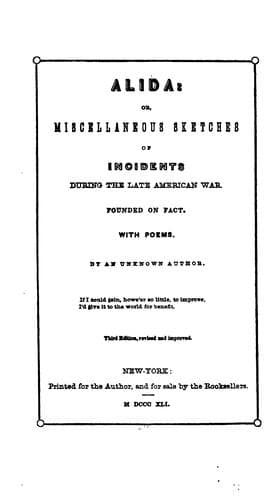
Alida; or, Miscellaneous Sketches of Incidents During the Late American War.: Founded on FactComfield, Amelia Stratton
History
Alida; or, Miscellaneous Sketches of Incidents During the Late American War.: Founded on Fact
Comfield, Amelia Stratton
United States -- History -- Revolution, 1775-1783 -- Juvenile fiction
A severe engagement had recently taken place within half a mile of the
Niagara cataract. General Scott, on his arrival at Niagara Falls,
learned that the British were in force directly in his front, separated
only by a narrow piece of wood. He soon pressed through the wood, and
engaged the British on the Queenstown road. He advanced upon the enemy,
and the action commenced at six o'clock in the afternoon, and continued
with little intermission until twelve at night. The thunder of the
cannon, the roaring of the falls, the incessant discharge of artillery
during the six hours in which the parties were in combat, heightened by
the circumstance of its being night, afforded such a scene as is rarely
to be met with in the history of the wars of nations. The evening was
calm, and the moon shone with lustre when not enveloped in clouds of
smoke from the firing of the contending armies. Taking into
consideration the numbers engaged, few contests have ever been more
sanguinary. The battle was one of the most severe that had been fought
during the war. The British troops engaged in this action amounted to
5000 men; many of them were selected from the flower of Lord
Wellington's army. Colonel Miller's achievement, in storming the
battery, was of the most brilliant and hazardous nature, and entitled
him to the highest applause among the Americans.
The measures of the president relative to the war were of such a nature
as greatly to draw upon him the approbation and gratitude of the nation.
He early began to turn his mind to a contemplation of the general
politics of his country. He, therefore, became advanced in the requisite
qualifications to assume and maintain the important station he held over
it. He had imbibed an attachment for civil liberty almost from his
infancy, which influenced his every action. He was of a pacific
temperament, and pursued those measures as long as they would answer.
But when it became actually necessary for him to recommend to congress
to pursue a different course, it was then that the benefactor of his
country endeavoured to concert measures still to preserve America as an
asylum for civil and religious liberty. He possessed qualities well
calculated to fulfil the duties of his high station with honour to
himself and justice to the community. He was dignified in his
deportment, kind, generous, and condescending; a patron to science;
a uniform promoter of honourable enterprise, but an enemy to every thing
dishonest, hypocritical, and disingenuous. And, as a Christian, he
firmly adhered to the gospel, and regulated his life by its precepts and
injunctions, in a consistent and exemplary manner. This illustrious
president had the good fortune to be blessed with a consort whose
qualifications in her particular capacity were no less adequate to fill
with dignity her elevated station. The parents of Mrs. Madison were
natives of Virginia. Their daughter was educated in Philadelphia among
the Friends.
Public-domain text, read in full here on John Shaqi.
Reviews
Reviews
No reviews yet
Be the first to share your thoughts on this work.
Join the Discussion
Join the discussion
Sign in to leave a comment or review.
Sign InorCreate an account