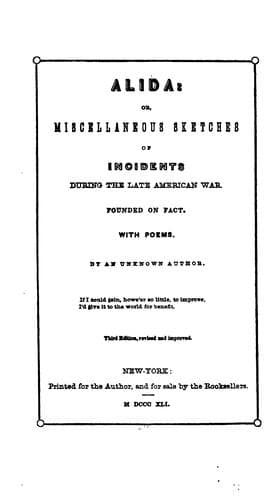
Alida; or, Miscellaneous Sketches of Incidents During the Late American War.: Founded on FactComfield, Amelia Stratton
History
Alida; or, Miscellaneous Sketches of Incidents During the Late American War.: Founded on Fact
Comfield, Amelia Stratton
United States -- History -- Revolution, 1775-1783 -- Juvenile fiction
A severe battle had lately taken place at New-Orleans, in which the
Americans were victorious. Another was fought some little time
afterwards on Lake Champlain. The British fleet, with 1050 men
approached Plattsburgh, while the American fleet were lying off that
place. The British fleet bore down upon them in order of battle,
commanded by sir George Prevost, Governor General of Canada. Commodore
Macdonough, the American commander, ordered his vessels to be cleared
for action, and gallantly received the enemy. The engagement was
exceedingly obstinate. After a contest of two hours, the British ships
and several sloops of war fell into the hands of the Americans. Before
sunset the temporary batteries of the enemy were all silenced, and every
attempt to cross from Plattsburgh to the American works was repelled. At
nine o'clock the object was abandoned, and the British general hastily
drew off his forces. Large quantities of military stores were left
behind, and fell into the hands of the Americans.
The people of the United States were at this time divided into two
political parties; one party condemned the war as unwise and
unnecessary; the other contending that the war was just, and necessary,
for the maintenance of national honour. The opposition to the war was
the greatest in the New England states, and during its continuance this
opposition was confirmed. Enlistments of troops were in some instances
discouraged, and dissentions arose between the general and state
governments, respecting the command of the militia, called out by order
of the former, to defend the sea-board. Accordingly the legislature of
Massachusetts appointed delegates to meet and confer with the delegates
from the states of New England, or any of them, upon the subject of
their public grievances and concerns. The delegates met at Hartford,
Connecticut, in 1815, and sat nearly three weeks with closed doors. This
convention consisted of delegates from the state of Massachusetts,
Connecticut, and Rhode Island; two members from New Hampshire, and one
from Vermont. After their adjournment, the convention published an
address, charging the nation with pursuing measures hostile to the
interest of New England, and recommended amendments to the Federal
Constitution. The report of the Hartford Convention concluded with the
resolution providing for the calling of another convention, should the
United States refuse their consent to some arrangements,--whereby the
New England States, separately, or in concert, might be empowered to
assume upon themselves the defence of their territory against the enemy.
The committee appointed to communicate these resolutions to Congress,
met at Washington the news of peace: and owing to this event, another
Convention was not called. And may it never be the fate of America, to
be again involved in hostilities with her mother country, from whence is
derived her revered religion;--each nation possessing towards the other
Public-domain text, read in full here on John Shaqi.
Reviews
Reviews
No reviews yet
Be the first to share your thoughts on this work.
Join the Discussion
Join the discussion
Sign in to leave a comment or review.
Sign InorCreate an account