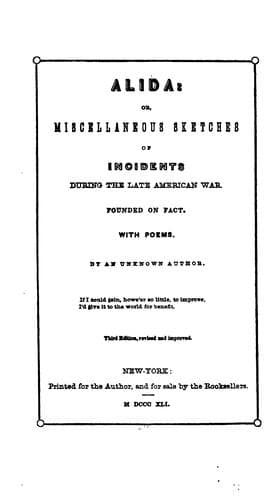
Alida; or, Miscellaneous Sketches of Incidents During the Late American War.: Founded on FactComfield, Amelia Stratton
History
Alida; or, Miscellaneous Sketches of Incidents During the Late American War.: Founded on Fact
Comfield, Amelia Stratton
United States -- History -- Revolution, 1775-1783 -- Juvenile fiction
After he had made to her these several propositions, her displeasure
held her for some time silent, while it affected her mind sensibly.
Nevertheless, she endeavoured to recover herself to answer him in a
decided, and, at the same time, in a manner compatible with her present
feelings. She commenced urging him to endeavour to forget her in any
other light than as a friend. "Can you suppose, Mr. Bolton," said she,
"that I would set a parent's will at defiance, by committing so unwary
an action as to dispose of myself in a clandestine manner, nor could you
again imagine that I would give my hand where my heart has no particular
regard." She scarcely uttered this, and could say no more ere he
conjured her not to shut her heart against him for ever, and entreated
her to permit him still to hope that after a while her compassion might
become awakened to the remembrance of a sincere, true, and constant
heart, which would cause her to heave the sympathetic sigh for one who
could never eradicate her from his memory, even for a moment, or chase
from his bosom the esteem and love that time could neither weaken nor
extinguish. He was extremely sorrowful in taking leave of Alida and the
family, and set out the ensuing day on his journey.
Alida felt unhappy at the earnest importunities of a person she could
not but have some esteem for. She could not fail to admire the superior
powers of his mind. In his conversation, he was all that was agreeable,
entertaining, and improving, which abounded with sallies of wit and
humour, joined to a fund of erudition acquired by a collegiate
education. He was particular to associate only with young men of merit,
talents, and genius. He possessed a native vein of satire, which he
sometimes indulged with much effect; though, however, he had this
dangerous weapon under such thorough discipline, that he rarely made use
of it in a way which gave offence to any. He never accumulated any
wealth by his own exertion, as he thought what he already inherited was
more than sufficient for all his wants. He seemed not to seek for an
abundance, like many others, as necessary to his happiness, thinking
that, with contentment, the peasant is greater than the prince destitute
of this benign blessing, and that a competency, rather than a
superfluity, could convey real happiness to man. He thought, that to the
improper pursuit after happiness could be attributed much of the misery
of mankind; daily he saw dread examples of this serious truth, that
many, in grasping at the shadow, had lost the substance. A near relative
had now been bountiful to leave him a fortune. That, however, he was
thankful for, as it increased his fund for charitable purposes. His
intention was to get possession of this and return to the city of
New-York, to make it his permanent residence.
CHAPTER XXII.
Public-domain text, read in full here on John Shaqi.
Reviews
Reviews
No reviews yet
Be the first to share your thoughts on this work.
Elsewhere in the archive
Join the Discussion
Join the discussion
Sign in to leave a comment or review.
Sign InorCreate an account