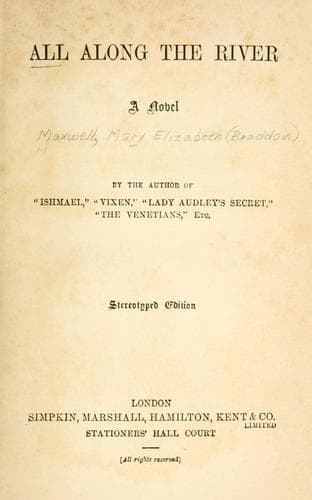
All along the River: A NovelBraddon, M. E. (Mary Elizabeth)
General
All along the River: A Novel
Braddon, M. E. (Mary Elizabeth)
English fiction -- 19th century
Tabitha made no such remarks. She was singularly silent and thoughtful,
as she stood looking down at the crowded room from her point of vantage
on the kitchen table. She had only eyes for one figure--the willowy
form in the glistening white satin gown, with the feathery Japanese
chrysanthemums, a little crushed and faded by this time; or perhaps it
may be said for two figures, since one followed the other as the shadow
follows the substance. She saw them waltzing together, when supper
was in full progress, and the room comparatively clear. She saw the
graceful head inclining towards his shoulder, the slender waist held in
his firm embrace; and it seemed to her that the waltz was an invention
of the Arch Enemy. She thought of it very much as people thought
seventy years ago when Byron wrote his poetical denunciation of the new
dance. She saw those two moving slowly towards an adjacent ante-room,
where banks of flowers, and a couple of sofas and low easy-chairs made
a retreat which was half boudoir, half conservatory. She saw them
moving side by side, talking to each other in tones so confidential
that his head bent low over hers each time she spoke; and then she
watched them sitting just within the doorway, at an angle where she
could see their faces, and attitudes, still in the same confidential
converse, she with downcast eyes, and he leaning forward with his
elbow on his knee, and looking up at her as he talked.
“It is too bad of him,” muttered Tabitha, writhing at that spectacle.
“Does he think what a child she is, and what harm he may be doing?
It is wicked of him, and he knows it; and other people must notice
them--other people must see what I see--and they will be talking of
her, blighting her good name. Oh, if I could only get her away at once
before people begin to notice her!”
She could see her young mistress’s face distinctly in the lamplight.
Isola was very pale, and her face was full of trouble; not the face
of a woman amusing herself with an idle flirtation, playing with fire
without the least intention of burning her fingers. There were plenty
of flirtations of that order going on in the Talbot ball-room; but this
was not one of them. This meant peril of some kind. This was all evil.
That pale face, those heavy eyelids, shrouding eyes which dared not
look up. That tremulous, uncertain movement of the snowy ostrich fan!
All these were danger signals.
“If I get her safe at home presently, I’ll open her eyes for her,”
thought Tabitha. “I’ll talk to her as if I was her mother. God knows I
should be almost as sorry as ever her mother could be if she came to
any harm.”
Public-domain text, read in full here on John Shaqi.
Reviews
Reviews
No reviews yet
Be the first to share your thoughts on this work.
Join the Discussion
Join the discussion
Sign in to leave a comment or review.
Sign InorCreate an account