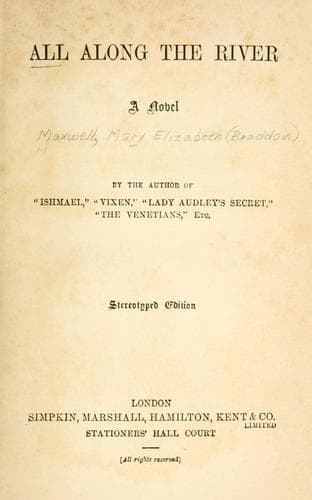
All along the River: A NovelBraddon, M. E. (Mary Elizabeth)
General
All along the River: A Novel
Braddon, M. E. (Mary Elizabeth)
English fiction -- 19th century
If she came to any harm. What harm was there to fear for her, as she
sat there, with Lostwithiel lounging across the low chair beside the
sofa where she sat, leaning forward to look into her downcast face?
What harm could come to her except that which meant destruction--death
to peace, and gladness, and womanly fame? If there were danger it was
a desperate danger, and Tabitha shuddered at the mere thought of that
peril.
“But, lor, she’s little more than a child,” mused Tabitha. “She means
no wrong, and she knows no wrong. She’s too innocent to come to any
harm.”
Yet in the landlady’s snuggery, by-and-by, seated at the comfortable
round table, with its spotless damask and bright glass and silver,
Tabitha was quite unable to do justice to that snack which Mr.
Tinkerly had ordered in her honour--a chicken and lobster-salad from
the supper-room, and three parts of a pine-apple cream. Susan and the
foreman fully appreciated these dainties; but Tabitha only munched a
crust and sipped a tumbler of beer.
“I’m a little bit out of sorts to-night,” she said.
“I hope you haven’t taken cold, Mrs. Thomas,” said the polite Tinkerly.
“Perhaps we ought to have brought another rug?”
“No, it isn’t that. I’ve been quite warm and comfortable. Eat your
supper, Mr. Tinkerly, and don’t bother about me. I’ve been interested
in looking on, and I’m too much took up with what I’ve seen to be able
to eat.”
“Well, it was a pretty sight,” exclaimed Tinkerly, enthusiastically;
“but I don’t think I ever saw such a mort of plain women in my life.”
“Lor, Mr. Tinkerly,” cried Susan, with a shocked air. “Why, look at our
young mistress, and at Miss Crowther, and Miss Spenthrop from Truro,
and Mrs. Pencarrow, and Lady Chanderville.”
“Well, I don’t say they’re all ugly. Some of ’em are handsome enough,
and there’s plenty of thorough-breds among ’em, but there’s a sight of
plain-headed ones. There’s quite as much beauty in your spear as there
is among the county folks, Miss Susan. I’ll answer for that.”
* * * * *
The night was waning. Isola had ordered her carriage for half-past two:
but three o’clock had struck from the church tower of Lostwithiel, and
the dance was still at its height--at its best, the dancers said, now
that the sensual attractions of the supper-room drew off a good many
people, and left the floor so much clearer than before supper, when
bulky middle-aged gentlemen, talking to the matrons seated upon the
divan, had projected their ponderous persons into the orbit of the
waltzers.
Isola and Lostwithiel had danced only two waltzes, but since two
o’clock they had sat out several dances, Mrs. Disney having cancelled
all her engagements after that hour by declaring that she would dance
no more.
“I am dreadfully tired,” she told her partners piteously, and her
pallor gave force to the assertion. “Please get some one else for
our dance, Captain Morshead,” and so on, and so on, to half a dozen
disappointed suitors.
Public-domain text, read in full here on John Shaqi.
Reviews
Reviews
No reviews yet
Be the first to share your thoughts on this work.
Join the Discussion
Join the discussion
Sign in to leave a comment or review.
Sign InorCreate an account