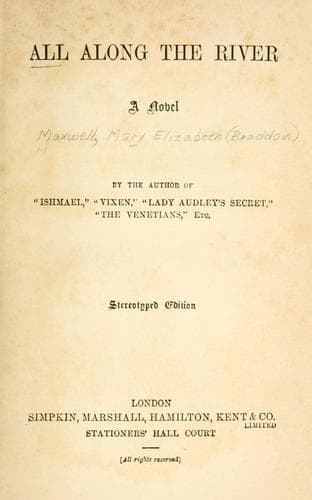
All along the River: A NovelBraddon, M. E. (Mary Elizabeth)
General
All along the River: A Novel
Braddon, M. E. (Mary Elizabeth)
English fiction -- 19th century
“Left you--altogether?” exclaimed Disney, with the tone of a man who
could scarcely believe in his own sense of hearing, so astounding was
the statement that met his ears. “Tabitha, my mother’s faithful old
servant, who was like my own flesh and blood! What in God’s name made
her leave you? Did you quarrel with her?”
He asked the question almost sternly. For the first time in his life
he was angry with this dear fragile creature, the idol of his heart.
He had loved Tabitha as servants are not often loved. He had left his
young wife in her charge, desiring no better custodian, full of faith
in Tabitha’s ability both to protect and counsel her girlish mistress.
“No, no; we did not quarrel. I liked Tabitha very much. I was almost as
fond of her as you yourself could be.”
“And yet you dismissed her!” Disney retorted bitterly. “She was not
smart enough for you, perhaps. Those Crowther people may have put it
into your head that she was old-fashioned--that you could never have a
modish household with such a humdrum old person at the head of it. Was
that your motive?”
“Oh, Martin, how can you think me so frivolous? I hate smartness
and pretension as much as you do. No, I should never have dismissed
Tabitha. She left me of her own accord.”
“Why?”
“She wanted rest. She was too old for service, she told me. I tried
to keep her. I humiliated myself so far as to beg her to stay
with me”--the tears came into her eyes at the mere memory of that
humiliation--“but she had made up her mind. She would not give way.”
“Where did she go?”
“To Falmouth--to live with her sister, a shoemaker’s widow. They let
lodgings, I believe.”
“She must have gone mad! A lodging-house must be harder work than
anything she had to do here.”
“Yes, I think it must.”
“When did she go?”
“At the beginning of the year--in January.”
“She left you six months ago, and in all that time you never told me
she was gone.”
“I did not want you to know, for fear you should be worried or vexed.”
“I should have been both; but you ought to have told me. I had a right
to know. I left you in her charge, Isola. You are much too young and
too pretty to be living alone without some kind of dragon--and I knew
Tabitha would be a very gentle dragon--a good motherly soul, able to
wait upon you and look after your health, and yet grim enough to keep
marauders off the premises. Indeed, my pet, you should have let me know
of her departure without an hour’s delay. She was very wrong to go. It
was a breach of faith I could never have expected.”
“Pray don’t be angry with her, Martin.”
“But I am angry. I have a right to be angry. I’ll go to Falmouth
to-morrow, and have it out with her.”
“No, no, pray don’t! We parted good friends. She can say nothing to you
more than she said to me. Pray don’t let there be any bad blood between
you. What could be gained by your going? To-morrow, too--our first day
together!”
Public-domain text, read in full here on John Shaqi.
Reviews
Reviews
No reviews yet
Be the first to share your thoughts on this work.
Elsewhere in the archive
Join the Discussion
Join the discussion
Sign in to leave a comment or review.
Sign InorCreate an account