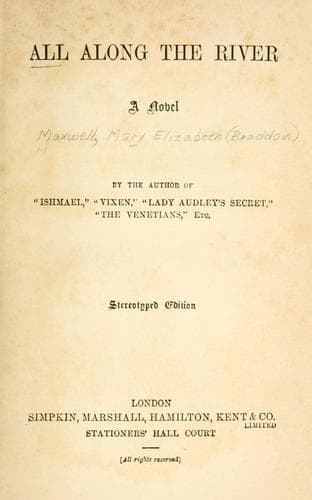
All along the River: A NovelBraddon, M. E. (Mary Elizabeth)
General
All along the River: A Novel
Braddon, M. E. (Mary Elizabeth)
English fiction -- 19th century
“I remember the hedge at Tregenna Castle before that good old place was
an inn,” said Martin; and then, having admired everything, he walked
up and down the grass beside the laurel hedge with his wife--while
the Satan-sent cook was spoiling the food that bounteous Nature had
provided for man’s enjoyment--and questioned her about the life she had
been leading in his absence.
“You used to write me such good letters, dearest, so full of detail,
that I knew exactly how your days were spent, and could picture every
hour of your life: but of late your descriptive powers have flagged. I
dare say you got tired of writing long letters to a dull old fellow in
India, who could never write you a clever letter in reply. It must have
seemed a one-sided business?”
“Indeed, no, dear. Your letters had only one fault. They were never
half long enough; but I knew how busy you were, and I thought it was so
good of you never to miss a mail.”
“Good of me! Had there been twice as many mails I would not have
willingly missed one. But there is no doubt your letters fell off after
last autumn. They were sweet, and ever welcome to me--but they told me
very little.”
“There was very little to tell.”
“Ah, but in the old days you used to make it seem so much. You had
such a delightful way of describing trifling events. I thought at one
time you had the makings of a Jane Austen; but afterwards I began to
fear you must be out of health. Your letters had a low-spirited tone.
There were no more of those sharp little touches which used to make me
laugh, no more of those tiny word-pictures, which brought the faces and
figures of my old neighbours before me.”
“You can hardly wonder if my spirits sank a little when you had been so
long away. And then life seemed so death-like in its monotony. There
were days when I felt I might just as well have been dead. There could
be very little difference between lying under the earth and crawling
listlessly on the top of it.”
“You were too much alone, Isola,” he answered, distressed at this
revelation. “You ought to have sent for Allegra. I begged you to send
for her, if you felt dull.”
“Do you think she could have cured my dulness?” exclaimed his wife,
impatiently. “Life would have seemed still more tiresome if I had been
obliged to talk when there was nothing to talk about, and to smile when
I felt inclined to cry.”
“Ah, you don’t know what a companion Allegra is--brimming over with
fun! She knows her Dickens by heart; and I never met with anybody who
appreciated him as intensely as she does.”
“I don’t care about Dickens.”
“Don’t--care--about Dickens!”
He echoed her words as if almost paralyzed by horror.
“Not as I used to care. One’s taste changes as life goes on. Lately I
have read nothing but Victor Hugo, and Keats, and Shelley.”
Public-domain text, read in full here on John Shaqi.
Reviews
Reviews
No reviews yet
Be the first to share your thoughts on this work.
Elsewhere in the archive
Join the Discussion
Join the discussion
Sign in to leave a comment or review.
Sign InorCreate an account