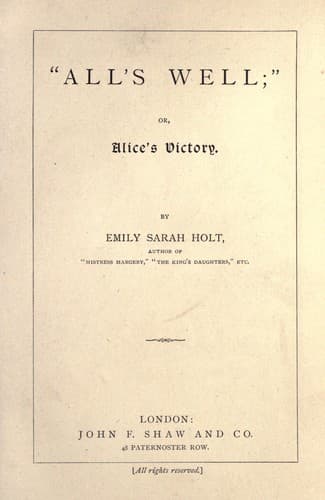
"All's Well"; or, Alice's VictoryHolt, Emily Sarah
General
"All's Well"; or, Alice's Victory
Holt, Emily Sarah
Counter-Reformation -- England -- Fiction; Historical fiction
"I am scarce so sure of that, my Christie. Satan can set snares even
for them that love the Lord; but 'tis true, they be not so like to slip
as they that do not. Is this young mistress she that dwelt away from
home some years back, or no?"
"She is, Father; she hath dwelt away in the shires, with her
grandmother, these five years. And there was a good man there--she told
me not his name--that gave her counsel, and he said, `To do God's work
is to do God's will.' That is good, Father, isn't it?"
"Good, and very true, sweeting."
Roger Hall had naturally all the contempt of a trueborn man of Kent for
the dwellers in "the shires," which practically meant everybody in
England who was not a native of Kent. But he knew that God had said,
"He that despiseth his neighbour sinneth;" so he said in his heart, "Get
thee behind me, Satan," to the bad feeling, and went on to wonder who
the good man might be. Had Pandora told the name of that man, half
Roger's doubts and terrors would have taken flight. The name of Master
John Bradford of Manchester--the martyr who eighteen months before had
glorified the Lord in the fires--would have been an immediate passport
to his confidence. But Pandora knew the danger of saying more than was
needful, and silently suppressed the name of her good counsellor.
Some days elapsed before Roger was again able to visit Canterbury. They
were very busy just then at the cloth-works, and his constant presence
was required. But when February began, the pressure was past, and on
the first holy-day in that month, which was Candlemas Day, he rode to
the metropolitan city of his county on another visit to Alice. On his
arm he carried a basket, which held a bottle of thick cream, a dozen
new-laid eggs, and a roll of butter; and as he came through Canterbury,
he added to these country luxuries the town dainties of a bag of dates
and half a pound each of those costly spices, much used and liked at
that time--cloves, nutmeg, and cinnamon. On these articles he spent 7
shillings 8 pence--8 pence for the dates, 3 shillings for cinnamon, 2
shillings 6 pence for cloves, and 1 shilling 6 pence for nutmegs.
Lastly, he bought a sugarloaf, then an unusual luxury, which cost him 7
pence. The basket was now quite full, and leaving his horse at the Star
Inn, he went up to the prison, and struck with his dagger on the great
bell, which was then the general mode of ringing it. Every man, except
labourers, carried a dagger. The porter had become so accustomed to the
sight of Roger, that he usually opened the door for him at once, with a
nod of greeting. But this morning, when he looked from the wicket to
see who it was, he did not open the door, but stood silently behind it.
Roger wondered what this new style of conduct meant.
"May I within, by your good leave, to see my sister?" he asked.
"You may within, if you desire to tarry here, by my Lord's good leave,"
said the porter; "but you'll not see your sister."
Public-domain text, read in full here on John Shaqi.
Reviews
Reviews
No reviews yet
Be the first to share your thoughts on this work.
Join the Discussion
Join the discussion
Sign in to leave a comment or review.
Sign InorCreate an account