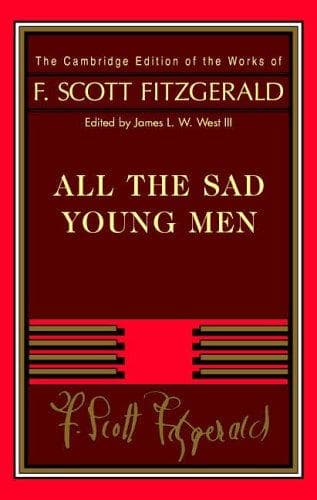
All the Sad Young MenFitzgerald, F. Scott (Francis Scott)
General
All the Sad Young Men
Fitzgerald, F. Scott (Francis Scott)
American fiction -- 20th century; Short stories, American
It was strange that neither when it was over nor a long time afterward
did he regret that night. Looking at it from the perspective of ten
years, the fact that Judy's flare for him endured just one month seemed
of little importance. Nor did it matter that by his yielding he
subjected himself to a deeper agony in the end and gave serious hurt to
Irene Scheerer and to Irene's parents, who had befriended him. There was
nothing sufficiently pictorial about Irene's grief to stamp itself on
his mind.
Dexter was at bottom hard-minded. The attitude of the city on his action
was of no importance to him, not because he was going to leave the city,
but because any outside attitude on the situation seemed superficial. He
was completely indifferent to popular opinion. Nor, when he had seen
that it was no use, that he did not possess in himself the power to move
fundamentally or to hold Judy Jones, did he bear any malice toward her.
He loved her, and he would love her until the day he was too old for
loving--but he could not have her. So he tasted the deep pain that is
reserved only for the strong, just as he had tasted for a little while
the deep happiness.
Even the ultimate falsity of the grounds upon which Judy terminated the
engagement that she did not want to "take him away" from Irene--Judy,
who had wanted nothing else--did not revolt him. He was beyond any
revulsion or any amusement.
He went East in February with the intention of selling out his laundries
and settling in New York--but the war came to America in March and
changed his plans. He returned to the West, handed over the management
of the business to his partner, and went into the first officers'
training-camp in late April. He was one of those young thousands who
greeted the war with a certain amount of relief, welcoming the
liberation from webs of tangled emotion.
VI
This story is not his biography, remember, although things creep into it
which have nothing to do with those dreams he had when he was young. We
are almost done with them and with him now. There is only one more
incident to be related here, and it happens seven years farther on.
It took place in New York, where he had done well--so well that there
were no barriers too high for him. He was thirty-two years old, and,
except for one flying trip immediately after the war, he had not been
West in seven years. A man named Devlin from Detroit came into his
office to see him in a business way, and then and there this incident
occurred, and closed out, so to speak, this particular side of his life.
"So you're from the Middle West," said the man Devlin with careless
curiosity. "That's funny--I thought men like you were probably born and
raised on Wall Street. You know--wife of one of my best friends in
Detroit came from your city. I was an usher at the wedding."
Dexter waited with no apprehension of what was coming.
"Judy Simms," said Devlin with no particular interest; "Judy Jones she
was once."
Public-domain text, read in full here on John Shaqi.
Reviews
Reviews
No reviews yet
Be the first to share your thoughts on this work.
Join the Discussion
Join the discussion
Sign in to leave a comment or review.
Sign InorCreate an account