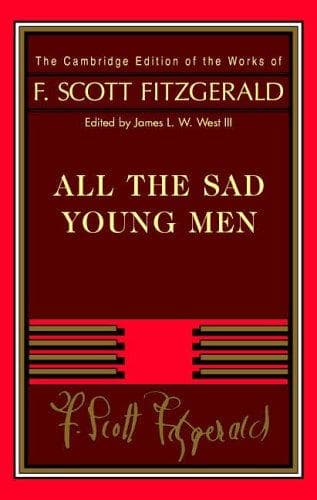
All the Sad Young MenFitzgerald, F. Scott (Francis Scott)
General
All the Sad Young Men
Fitzgerald, F. Scott (Francis Scott)
American fiction -- 20th century; Short stories, American
The directness of this confused him. He should have told her now that he
was going to marry another girl, but he could not tell her. He could as
easily have sworn that he had never loved her.
"I think we'd get along," she continued, on the same note, "unless
probably you've forgotten me and fallen in love with another girl."
Her confidence was obviously enormous. She had said, in effect, that she
found such a thing impossible to believe, that if it were true he had
merely committed a childish indiscretion--and probably to show off. She
would forgive him, because it was not a matter of any moment but rather
something to be brushed aside lightly.
"Of course you could never love anybody but me," she continued, "I like
the way you love me. Oh, Dexter, have you forgotten last year?"
"No, I haven't forgotten."
"Neither have I!"
Was she sincerely moved--or was she carried along by the wave of her own
acting?
"I wish we could be like that again," she said, and he forced himself to
answer:
"I don't think we can."
"I suppose not.... I hear you're giving Irene Scheerer a violent rush."
There was not the faintest emphasis on the name, yet Dexter was suddenly
ashamed.
"Oh, take me home," cried Judy suddenly; "I don't want to go back to
that idiotic dance--with those children."
Then, as he turned up the street that led to the residence district,
Judy began to cry quietly to herself. He had never seen her cry before.
The dark street lightened, the dwellings of the rich loomed up around
them, he stopped his coupé in front of the great white bulk of the
Mortimer Joneses house, somnolent, gorgeous, drenched with the splendor
of the damp moonlight. Its solidity startled him. The strong walls, the
steel of the girders, the breadth and beam and pomp of it were there
only to bring out the contrast with the young beauty beside him. It was
sturdy to accentuate her slightness--as if to show what a breeze could
be generated by a butterfly's wing.
He sat perfectly quiet, his nerves in wild clamor, afraid that if he
moved he would find her irresistibly in his arms. Two tears had rolled
down her wet face and trembled on her upper lip.
"I'm more beautiful than anybody else," she said brokenly, "why can't I
be happy?" Her moist eyes tore at his stability--her mouth turned slowly
downward with an exquisite sadness: "I'd like to marry you if you'll
have me, Dexter. I suppose you think I'm not worth having, but I'll be
so beautiful for you, Dexter."
A million phrases of anger, pride, passion, hatred, tenderness fought on
his lips. Then a perfect wave of emotion washed over him, carrying off
with it a sediment of wisdom, of convention, of doubt, of honor. This
was his girl who was speaking, his own, his beautiful, his pride.
"Won't you come in?" He heard her draw in her breath sharply.
Waiting.
"All right," his voice was trembling, "I'll come in."
V
Public-domain text, read in full here on John Shaqi.
Reviews
Reviews
No reviews yet
Be the first to share your thoughts on this work.
Join the Discussion
Join the discussion
Sign in to leave a comment or review.
Sign InorCreate an account