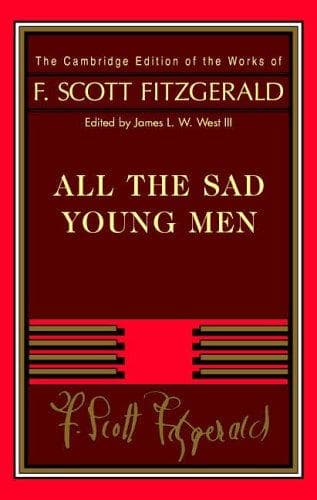
All the Sad Young MenFitzgerald, F. Scott (Francis Scott)
General
All the Sad Young Men
Fitzgerald, F. Scott (Francis Scott)
American fiction -- 20th century; Short stories, American
John Andros waited until she had closed the door behind her; then he
reached over into the bed, and picking up his daughter, blankets and
all, sat down in the rocking-chair holding her tightly in his arms. She
moved a little, and he held his breath, but she was sleeping soundly,
and in a moment she was resting quietly in the hollow of his elbow.
Slowly he bent his head until his cheek was against her bright hair.
"Dear little girl," he whispered. "Dear little girl, dear little girl."
John Andros knew at length what it was he had fought for so savagely
that evening. He had it now, he possessed it forever, and for some time
he sat there rocking very slowly to and fro in the darkness.
ABSOLUTION
There was once a priest with cold, watery eyes, who, in the still of the
night, wept cold tears. He wept because the afternoons were warm and
long, and he was unable to attain a complete mystical union with our
Lord. Sometimes, near four o'clock, there was a rustle of Swede girls
along the path by his window, and in their shrill laughter he found a
terrible dissonance that made him pray aloud for the twilight to come.
At twilight the laughter and the voices were quieter, but several times
he had walked past Romberg's Drug Store when it was dusk and the yellow
lights shone inside and the nickel taps of the soda-fountain were
gleaming, and he had found the scent of cheap toilet soap desperately
sweet upon the air. He passed that way when he returned from hearing
confessions on Saturday nights, and he grew careful to walk on the other
side of the street so that the smell of the soap would float upward
before it reached his nostrils as it drifted, rather like incense,
toward the summer moon.
But there was no escape from the hot madness of four o'clock. From his
window, as far as he could see, the Dakota wheat thronged the valley of
the Red River. The wheat was terrible to look upon and the carpet
pattern to which in agony he bent his eyes sent his thought brooding
through grotesque labyrinths, open always to the unavoidable sun.
One afternoon when he had reached the point where the mind runs down
like an old clock, his housekeeper brought into his study a beautiful,
intense little boy of eleven named Rudolph Miller. The little boy sat
down in a patch of sunshine, and the priest, at his walnut desk,
pretended to be very busy. This was to conceal his relief that some one
had come into his haunted room.
Presently he turned around and found himself staring into two enormous,
staccato eyes, lit with gleaming points of cobalt light. For a moment
their expression startled him--then he saw that his visitor was in a
state of abject fear.
"Your mouth is trembling," said Father Schwartz, in a haggard voice.
The little boy covered his quivering mouth with his hand.
"Are you in trouble?" asked Father Schwartz, sharply. "Take your hand
away from your mouth and tell me what's the matter."
Public-domain text, read in full here on John Shaqi.
Reviews
Reviews
No reviews yet
Be the first to share your thoughts on this work.
Elsewhere in the archive
Join the Discussion
Join the discussion
Sign in to leave a comment or review.
Sign InorCreate an account