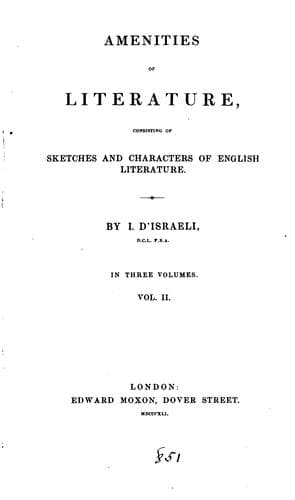
Amenities of Literature: Consisting of Sketches and Characters of English LiteratureDisraeli, Isaac
History
Amenities of Literature: Consisting of Sketches and Characters of English Literature
Disraeli, Isaac
Authors, English -- Biography; English literature -- History and criticism; Great Britain -- Intellectual life
And like Thersites, the son of Eglaff receives a blasting reproach:--"I
tell thee, son of Eglaff, drunken with mead, that I have greater
strength upon the sea than any other man. We two (he alludes to his
competitor), when we were but boys, with our naked swords in our hands,
where the waves were fiercest, warred with the walruses. The whale-fish
dragged me to the bottom of the sea, grim in his gripe; the mighty
sea-beast received the war-rush through my hand. The sea became calm, so
that I beheld the ocean promontories, as the light broke from the east.
Never since have the sea-sailors been hindered of their way; never have
I heard of a harder battle by night under the concave of heaven, nor of
a man more wretched on the ocean-streams. Of such ambushes and fervour
of swords I have not heard aught of thee, else had the fiend I come to
vanquish never accomplished such horrors against thy prince. I boast
not, therefore, son of Eglaff! but never have I slaughtered those of my
kin, for which hast thou incurred damnation, though thy wit be good."
In this state of imperfect civilization, we discover already a right
conception of the female character. At the banquet the queen appears;
she greeted the young Goth, bearing in her own hand the bright sweet
liquor in the twisted mead-cup. She went among the young and the old
mindful of their races; the free-born queen then sate beside the
monarch. There was laughter of heroes. A bard sung serene on "the origin
of things," as Iopas sang at the court of Dido, and Demodocus at that of
Alcinous. The same bard again excites joy in the hall by some warlike
tale. Never was banquet without poet in the Homeric times.
Here our task ends, which was not to analyse the tale of Beowulf, but
solely to exhibit the manners of a primeval epoch in society. The whole
romance, though but short, bears another striking feature of the mighty
minstrel of antiquity; it is far more dramatic than narrative, for the
characters discover themselves more by dialogue than by action.
The literary history of this Anglo-Saxon metrical romance is too
remarkable to be omitted. It not only cast a new light on a disputed
object in our own literary history, but awoke the patriotism of a
foreign nation. Beowulf had shared the fate of Cædmon, being preserved
only in a single manuscript in the Cottonian Library, where it escaped
from the destructive fire of 1731, not, however, without injury. In
1705, Wanley had attempted to describe it, but he did not surmount the
difficulty. Our literary antiquaries, with Ritson for their leader,
stubbornly asserted that the Anglo-Saxons had no metrical romance, as
they opined by their scanty remains. The learned historian of our
Anglo-Saxons, in the progress of his ceaseless pursuit, unburied this
hidden treasure--which at once refuted the prevalent notions; but this
literary curiosity was fated to excite deeper emotions among the honest
Danes.
Public-domain text, read in full here on John Shaqi.
Reviews
Reviews
No reviews yet
Be the first to share your thoughts on this work.
Join the Discussion
Join the discussion
Sign in to leave a comment or review.
Sign InorCreate an account