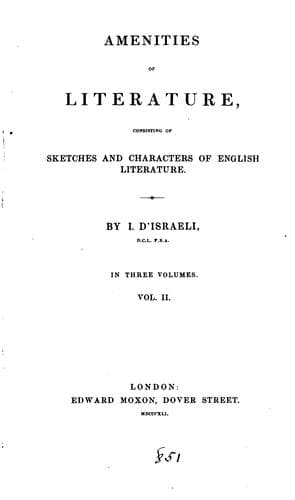
Amenities of Literature: Consisting of Sketches and Characters of English LiteratureDisraeli, Isaac
History
Amenities of Literature: Consisting of Sketches and Characters of English Literature
Disraeli, Isaac
Authors, English -- Biography; English literature -- History and criticism; Great Britain -- Intellectual life
During this mysterious and protracted visit, and apparent abandonment of
his new kingdom to the care of others, was a vast scheme of dominion
nursed in the councils of Norman nobles, and strengthened by the
boundless devotion of hardy adventurers, who were all to share in the
present spoliation and the future royalty? In his prescient view did
William there anticipate a conquest of long labour and of distant days;
the state, the nobles, the ecclesiastics, the people, the land, and the
language, all to be changed? Hume has ventured to surmise that the mind
of the Norman laboured with this gigantic fabric of dominion. It is
probable, however, that this child of a novel policy was submitted to a
more natural gestation, and expanded as circumstances favoured its awful
growth. One night in December the King suddenly appeared in England, and
soon unlimited confiscations and royal grants apportioned the land of
the Saxons among the lords of Normandy, and even their lance-bearers. It
seemed as if every new-comer brought his castles with him, so rapidly
did castles cover the soil.[4] These were strongholds for the tyrant
foreigner, or open retreats for his predatory bands; stern overlookers
were they of the land!
The Norman lords had courts of their own; sworn vassals to their
suzerain, but kinglings to the people. Sometimes they beheld a Saxon
lord, whose heart could not tear itself from the lands of his race, a
serf on his own soil; but they witnessed without remorse the rights of
the sword. Norman prelates were silently substituted for Saxon
ecclesiastics, and whole companies of claimants arrived to steal into
benefices or rush into abbeys. It was sufficient to be a foreigner and
land in England, to become a bishop or an abbot. Church and State were
now indissolubly joined, for in the general plunder each took their
orderly rank. It was the triumph of an enlightened, perhaps a cunning
race, as the Norman has been proverbially commemorated, over "a rustic
and almost an illiterate generation," as the simplicity of our Saxon
prelates, who could not always speak French, is described by Ordericus
Vitalis, a monk who, long absent from England, wrote in Normandy.
Ingulphus, the monk of Croyland, though partial to "the Conqueror,"
however, honestly confesses that when the English were driven from their
dignities, their successors were not always their superiors.
Public-domain text, read in full here on John Shaqi.
Reviews
Reviews
No reviews yet
Be the first to share your thoughts on this work.
Elsewhere in the archive
Join the Discussion
Join the discussion
Sign in to leave a comment or review.
Sign InorCreate an account