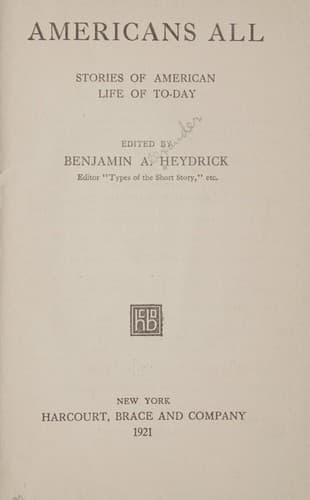
Short stories, American; United States -- Social life and customs -- Fiction
He came, and from that time made New York his home, becoming very fond
of Little Old-Bagdad-on-the-Subway as he called it.
He had found the work which he wished to do, and he turned out stories
very rapidly. These were first published in newspapers and magazines,
then collected in book form. The first of these volumes, _Cabbages and
Kings_, had Central America as its setting. He said that while there he
had knocked around chiefly with refugees and consuls. _The Four Million_
was a group of stories of New York; it contained some of his best tales,
such as "The Gift of the Magi," and "An Unfinished Story." _The Trimmed
Lamp_ and _The Voice of the City_ also dealt with New York. _The Gentle
Grafter_ was a collection of stories about confidence men and "crooks."
The material for these narratives he had gathered from his companions in
his prison days. _Heart of the West_ reflects his days on a Texas
ranch. Other books, more or less miscellaneous in their locality, are
_Roads of Destiny_, _Options_, _Strictly Business_, _Whirligigs_; and
_Sixes and Sevens_. He died in New York, June 5, 1910. After his death a
volume containing some of his earliest work was published under the
title _Rolling Stones_.
His choice of subjects is thus indicated in the preface to _The Four
Million_:
"Not very long ago some one invented the assertion that there were only
'Four Hundred' people in New York who were really worth noticing. But a
wiser man has arisen--the census taker--and his larger estimate of human
interest has been preferred in marking out the field of these little
stories of the 'Four Million.'"
It was the common man,--the clerk, the bartender, the policeman, the
waiter, the tramp, that O. Henry chose for his characters. He loved to
talk to chance acquaintances on park benches or in cheap lodging houses,
to see life from their point of view. His stories are often of the
picaresque type; a name given to a kind of story in which the hero is an
adventurer, sometimes a rogue. He sees the common humanity, and the
redeeming traits even in these. His plots usually have a turn of
surprise at the end; sometimes the very last sentence suddenly
illuminates the whole story. His style is quick, nervous, often slangy;
he is wonderfully dextrous in hitting just the right word or phrase. His
descriptions are notable for telling much in a few words. He has almost
established a definite type of short story writing, and in many of the
stories now written one may clearly see the influence of O. Henry.
IN POLITICS
Public-domain text, read in full here on John Shaqi.
Reviews
Reviews
No reviews yet
Be the first to share your thoughts on this work.
Elsewhere in the archive
Join the Discussion
Join the discussion
Sign in to leave a comment or review.
Sign InorCreate an account