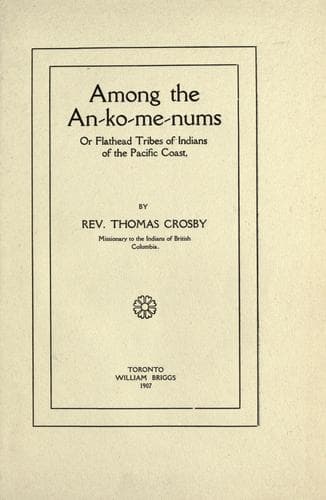
Among the An-ko-me-nums, or Flathead Tribes of Indians of the Pacific CoastCrosby, Thomas
History
Among the An-ko-me-nums, or Flathead Tribes of Indians of the Pacific Coast
Crosby, Thomas
Indians of North America -- Missions; Salish Indians
This ended, the bridegroom called his young men to him, and rushing
up to the large canoe where the young bride sat almost covered with
blankets, they seized the canoe and with a merry shout gave it a heave,
when it bounded off the bank into the water, some of them holding it
back for fear it should launch out too far.
As a parting gift the young man took off his coat and hat and gave them
to Tsil-ka-mut, who was clothed in a blanket only. The gift, it seemed,
could be of little value, as the young fellow was quite slender, while
the old chief looked as large again.
This done the young man sprang into the canoe by the side of his
bride, and they were man and wife. In a moment some ten of his braves
followed him, and seizing their paddles swung the big canoe out into
the bay and the party was off. We on the beach shouted and waved our
good-byes until they rounded the point.
THE SAD STATE OF HEATHEN WOMANHOOD.
Polygamy, with all its dreadful misery and degradation, was prevalent
in former days all along the coast. Chee-at-luk, the old king of the
Songees, commonly known as King Free-zee, it is said had fifteen wives.
In the interior, also, I met a chief who claimed to have fourteen
wives. One or two of these were the chief or permanent wives, while all
the rest were treated like slaves, and possibly were slaves, purchased
and often held as such.
Years ago, it is said, a man’s own sister, or, worse still, even his
daughter or mother, might be among his wives. The more wives he had,
the less work he would have to do. A great chief is reported to have
said, “Women are made to labor; one of them can haul as much as two
men; they pitch our tents, carry our wood, mend our clothes, and cook
our food.”
Woman was always the slave or burden-bearer until the Gospel came and
lifted her into her true social position.
It was a common thing, in those first days of my work among them, to
see a man with his blanket on, painted up in great style, walking along
the road as if the whole creation belonged to him, while a poor woman,
with a heavy load of fish or food of some kind in a basket on her
back, trudged along, hardly able to bear up under the load, and perhaps
carrying a baby besides. If you said to the man, as I have said again
and again, “Take the baby. Why don’t you help her?” she would say, “Oh,
let him alone, sir; he is the chief,” as much as to say, “I am his
slave.”
It was very common for men to have from two to four wives, and there
was often a great deal of jealousy and quarrelling among them. This
custom worked great injury to many of the young men, who could not get
wives, and often led them to live reckless lives; while many a young
woman has gone off to ruin for fear she would have to go and live with
some ill-natured, dirty, lame old fellow whom she could never like.
Public-domain text, read in full here on John Shaqi.
Reviews
Reviews
No reviews yet
Be the first to share your thoughts on this work.
Join the Discussion
Join the discussion
Sign in to leave a comment or review.
Sign InorCreate an account