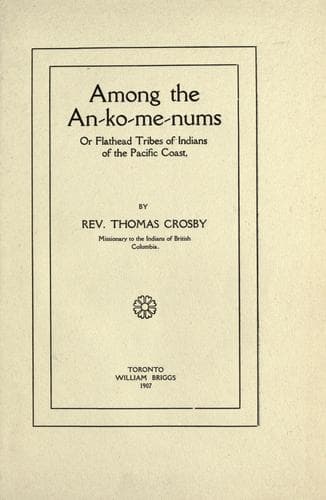
Among the An-ko-me-nums, or Flathead Tribes of Indians of the Pacific CoastCrosby, Thomas
History
Among the An-ko-me-nums, or Flathead Tribes of Indians of the Pacific Coast
Crosby, Thomas
Indians of North America -- Missions; Salish Indians
When it was desired to broil the salmon, birds, venison or other wild
meats, a stick the size of a broom handle, about four feet long, was
split part way down, and the meat or fish was put into the split, while
little sticks were placed crossways to keep the food spread. The stick
was then tied at the split end, while the other end, already sharpened,
was driven into the ground by the hot camp-fire, the flat side being
kept towards the fire. The oil or gravy was caught in a clam shell or
other dish and poured back upon the meat while cooking. Salmon never
tastes better than when cooked in this manner. Often when travelling by
canoe have we had deer, bear or mountain-goat meat, ducks or geese, and
even porcupine, eagle or gulls, cooked in this way. The latter is quite
palatable when you are worn with travelling and the larder has become
nearly exhausted.
FEASTS.
It has been said, “It is always a feast or a famine with a native.”
Whether that is true or not, certain it is that the natives of the
Pacific Coast have a great variety of feasts. Indians, wherever you
find them, are very hospitable to strangers--the travellers and miners
of this vast country would all testify to this. They are most generous,
even reckless, with their food. If you are invited to a feast among
them the food is piled up before you, and after having satisfied your
appetite you are expected to take away all you cannot eat. If the
visitor is a chief or important person, what he has left is sent home
by messenger to his family. If he be any ordinary guest, he sweeps off
what remains--which is usually much more than he has eaten--into a
corner of his blanket or his shirt, and carries it away. If the feast
be of whale’s blubber, porpoise, fish of similar kind, or venison, bear
or mountain goat, it is cut up into slices and strung on a sharp stick,
or carried in his hand to the rest of his family.
At a big feast there are always several masters of ceremonies and a
number of waiters in attendance. These never sit down while the eating
is going on, though often a feast will last for six or seven hours,
having as many courses. There are numerous small, every-day feasts
where neighbors call upon each other in a happy, social way.
One of the greatest offences to an Indian is to refuse to accept an
invitation which he has given you to eat with him and his friends.
MUSIC AND DANCING.
With most feasting is usually associated dancing and other merriment.
Public-domain text, read in full here on John Shaqi.
Reviews
Reviews
No reviews yet
Be the first to share your thoughts on this work.
Join the Discussion
Join the discussion
Sign in to leave a comment or review.
Sign InorCreate an account