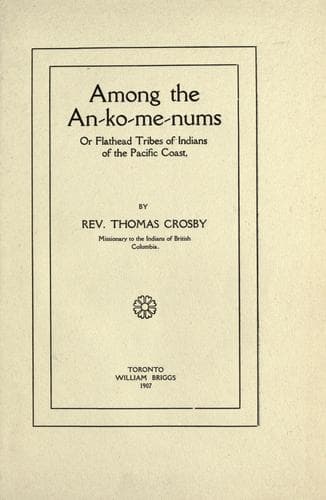
Among the An-ko-me-nums, or Flathead Tribes of Indians of the Pacific CoastCrosby, Thomas
History
Among the An-ko-me-nums, or Flathead Tribes of Indians of the Pacific Coast
Crosby, Thomas
Indians of North America -- Missions; Salish Indians
Its outward manifestation of the heathen feast and dance, with the
giving of gifts to all present, is bad enough, but this is as nothing
to the unseen influence behind it all.
The potlatch relates to all the life of the people, such as the giving
of names, the raising into social position, their marriages, deaths and
burials.
A man desires, or thinks himself entitled to, some coveted position,
property or distinction, and for years, perhaps, makes preparation to
secure it. This can only be done by the law of “tlaa-nuk” (potlatch),
and so when ready he calls together from far and near his friends and
relatives, when, after much feasting and dancing and speech-making,
he gets up on a high platform and proceeds to give away all that he
possesses.
The ambition of an Indian to be thought greater, richer and more
influential than any of his neighbors leads him not only to give away
a large part of his goods--which, as a matter of fact, he expects
returned with interest on some future occasion, at another such
gathering--but wantonly to destroy very much in such a manner that it
can never be restored. For instance, think of a man taking a fine large
canoe, valued at, perhaps, one hundred and fifty dollars, and smashing
it into pieces; or of another seizing a number of beautiful new guns
or rifles and bending and breaking them so that they would be utterly
useless; or of another setting fire to piles of food and of goods. Some
few years ago, at one such gathering, the poor, foolish creatures took
rolls of new bills, the product of their summer’s work, and threw them
into the fire.
I knew a man at Nanaimo who, together with his wives and children,
worked for years saving and getting together much property; and then a
great potlatch was given, and everything went, to the last stitch of
clothing, and he and his family were left practically naked to face the
winter, without any provisions. His children nearly starved, while he
contracted a cold which led to consumption, from which he died.
Some time ago it was rumored that the law against the potlatch was to
be repealed. This drew a strong protest from several quarters, among
them from some of the Indians themselves.
About that time the following letter, which explains itself, appeared
in the local press, signed by an Indian whose identity was vouched for
by a gentleman who knew him well:
“Having heard that in the last session of the provincial parliament
a resolution was passed asking Dominion Government to reconsider the
potlatch question with a view to repealing section 114, and that there
is to be an inquiry as to the evils of the potlatch, we should like to
tell the public what the potlatch is.
Public-domain text, read in full here on John Shaqi.
Reviews
Reviews
No reviews yet
Be the first to share your thoughts on this work.
Join the Discussion
Join the discussion
Sign in to leave a comment or review.
Sign InorCreate an account