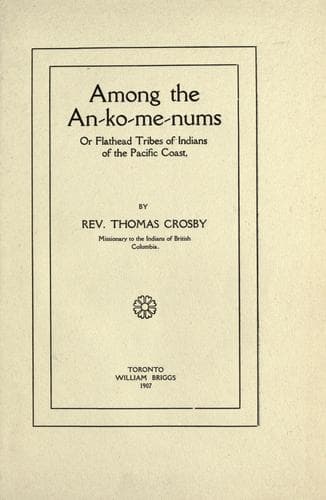
Among the An-ko-me-nums, or Flathead Tribes of Indians of the Pacific CoastCrosby, Thomas
History
Among the An-ko-me-nums, or Flathead Tribes of Indians of the Pacific Coast
Crosby, Thomas
Indians of North America -- Missions; Salish Indians
The gamblers would sit opposite each other on the grass or in the large
houses, and a great crowd would gather on both sides, making a rattling
noise with short sticks on boards, and singing to work themselves up
for luck, or “power,” as they called it. The gambling would go on night
and day, almost week in and week out, until they had not a shred of
clothes left. Money, muskets, canoes, horses, and sometimes the houses
over their heads, they would stake on a chance.
The story is told of one old man among the Kling-gets who gambled away
everything he had. Then, with the hope that he would have a lucky
day some time, he put himself down and gambled away for days, still
losing, until his wife, seeing that he was “going,” persuaded him to
stop. She had to pay two hundred blankets to buy him back.
The gambling passion still lives with them, and now some of them have
adopted the methods of their white brothers--they were always fond of
imitating him, even to their own hurt--and are going deeper and deeper
into sin.
CHAPTER XII. _NATIVE WORSHIP AND SUPERSTITIONS._
“Ye whose hearts are fresh and simple,
Who have faith in God and Nature,
Who believe, that in all ages
Every human heart is human,
That in even savage bosoms
There are longings, yearnings, strivings,
For the good they comprehend not,
That the feeble hands and helpless,
Groping blindly in the darkness,
Touch God’s right hand in that darkness
And are lifted up and strengthened....”
--“_Hiawatha._”
The An-ko-me-nums, like most of the Indians of British Columbia, were
spirit worshippers. First of all, they believed in a great Chief
Spirit, who created all things and was all-wise and all-powerful, and
ruled over them for good, but who was not actively concerned for them,
and whom they never called upon except in cases of great difficulty or
distress.
Then they believed in a multitude of lesser spirits, who were in
most cases evilly disposed towards them. These inhabited certain
mountains and headlands and rocky, dangerous points, around which the
waves raged and tossed their frail canoes, and sometimes upset them.
A swirling eddy, a dangerous rapid, a lonely lake in the mountains,
a steep precipice where perhaps at some time or other one of their
people had met with disaster and possibly death, was the abode of a
“Stlaw-la-kum,” or evil spirit.
They prayed a great deal to the sun, to the moon, to the Great Being
who gave them all the fish and food, or to the spirit whom they
believed might be responsible for any impending danger. They were often
found in the woods praying. Hunters would pray and fast for days in
the mountains, bathing themselves and performing certain exercises, in
order to be successful hunters. They would pray, while fishing, for a
successful catch. And for weeks before going on a war expedition they
would fast and pray and bathe and paint themselves in preparation for
the undertaking.
Public-domain text, read in full here on John Shaqi.
Reviews
Reviews
No reviews yet
Be the first to share your thoughts on this work.
Elsewhere in the archive
Join the Discussion
Join the discussion
Sign in to leave a comment or review.
Sign InorCreate an account