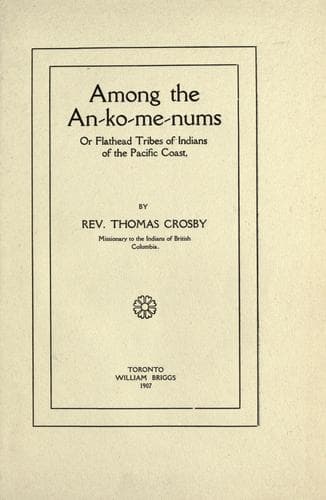
Among the An-ko-me-nums, or Flathead Tribes of Indians of the Pacific CoastCrosby, Thomas
History
Among the An-ko-me-nums, or Flathead Tribes of Indians of the Pacific Coast
Crosby, Thomas
Indians of North America -- Missions; Salish Indians
In many cases the grave-diggers found poor creatures almost, but not
altogether, dead; they knew they would be fit for burial soon, and did
not care to spend time waiting for the last gasp. It is said they were
taking one poor fellow off to the grave, but he objected on the very
proper ground that he was not dead yet. He was told to shut up, as he
was dead, but too delirious to comprehend the fact. So they carefully
placed him under the sod to await the resurrection morn.
RISING FROM THE GRAVE.
The coal company at Nanaimo were building a wharf from a point in the
harbor, and paid for the removal of a number of Indian bodies which had
been buried near the spot. New graves were dug on a little side hill,
and to these the remains were transferred. The holes, however, were
quite shallow, owing to the presence of a clay hard-pan underneath.
Next day a great outcry was made in the camp, and intense excitement
prevailed, for most of the boxes had risen up and had come out of the
graves. We went down to discover the cause of the disturbance, and what
had seemed to the poor people so strange and uncanny had been caused
by the heavy rain of the night before filling the shallow graves and
floating out what they contained. It took some time to quiet the fears
of the people.
The men who do anything in any way in the digging of the grave or the
handling of the body are paid excessively for their services. This may
be due, in part, to their horrible fear of the dead.
MOURNING FOR THE DEAD.
The Indian mother grieves for her children with the same intensity
of feeling that characterizes her white sister. After the burial she
will return to the grave in the early morning and weep bitterly. She
often continues this for days at a time. She wails and calls up the
looks of the little one, its acts and words. She will carry the clothes
and playthings to the little grave, and cry and talk away to her lost
darling, and pathetically plead for its return.
There is, however, a kind of professionalism about a great deal of
their mourning for the dead. When a chief or leading person had passed
away women were accustomed to rush into the house from all parts of
the village. Perhaps on their way there they might be chatting and
laughing about trifles, but as soon as they got near the house where
the dead lay, they would commence rubbing their hands down their faces,
and really seem to pump up their tears, for before they were fairly
seated the tears were flowing, while they wailed and told all the good
qualities of the dead.
After this had gone on for some time, someone belonging to the house
would hand around a dish or basket containing water. The crying then
ceased, and dipping their fingers in the water they bathed faces and
hands, and received the strips of calico or clothes of the deceased,
which was their reward for their weeping.
THE WITCH-DOCTOR.
Public-domain text, read in full here on John Shaqi.
Reviews
Reviews
No reviews yet
Be the first to share your thoughts on this work.
Elsewhere in the archive
Join the Discussion
Join the discussion
Sign in to leave a comment or review.
Sign InorCreate an account