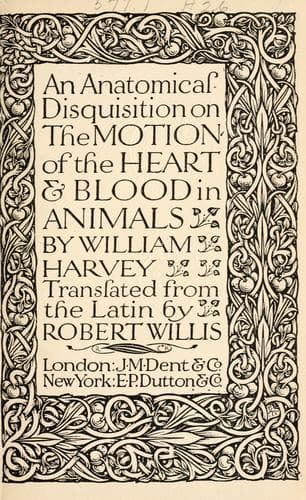
An anatomical disquisition on the motion of the heart & blood in animals — John Shaqi
An anatomical disquisition on the motion of the heart & blood in animalsHarvey, William
Science
An anatomical disquisition on the motion of the heart & blood in animals
Harvey, William
Blood -- Circulation
In embryos, consequently, whilst the lungs are yet in a state of
inaction, performing no function, subject to no motion any more than
if they had not been present, nature uses the two ventricles of the
heart as if they formed but one, for the transmission of the blood.
The condition of the embryos of those animals which have lungs, whilst
these organs are yet in abeyance and not employed, is the same as that
of those animals which have no lungs.
So clearly, therefore, does it appear in the case of the fœtus, viz.
that the heart by its action transfers the blood from the vena cava
into the aorta, and that by a route as obvious and open, as if in
the adult the two ventricles were made to communicate by the removal
of their septum. Since, then, we find that in the greater number of
animals, in all, indeed, at a certain period of their existence,
the channels for the transmission of the blood through the heart
are so conspicuous, we have still to inquire wherefore in some
creatures--those, namely, that have warm blood, and that have attained
to the adult age, man among the number--we should not conclude that the
same thing is accomplished through the substance of the lungs, which
in the embryo, and at a time when the function of these organs is in
abeyance, nature effects by the direct passages described, and which,
indeed, she seems compelled to adopt through want of a passage by the
lungs; or wherefore it should be better (for nature always does that
which is best) that she should close up the various open routes which
she had formerly made use of in the embryo and fœtus, and still uses in
all other animals; not only opening up no new apparent channels for the
passage of the blood, therefore, but even entirely shutting up those
which formerly existed.
Public-domain text, read in full here on John Shaqi.
Reviews
Reviews
No reviews yet
Be the first to share your thoughts on this work.
Join the Discussion
Join the discussion
Sign in to leave a comment or review.
Sign InorCreate an account