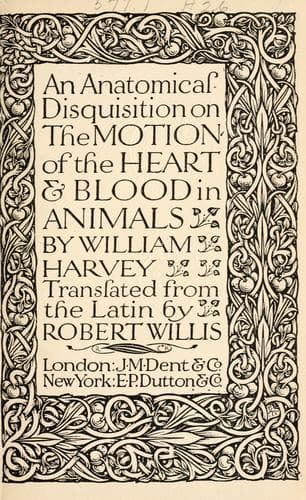
An anatomical disquisition on the motion of the heart & blood in animals — John Shaqi
An anatomical disquisition on the motion of the heart & blood in animalsHarvey, William
Science
An anatomical disquisition on the motion of the heart & blood in animals
Harvey, William
Blood -- Circulation
What is commonly said in regard to these two great communications,
to wit, that they exist for the nutrition of the lungs, is both
improbable and inconsistent; seeing that in the adult they are closed
up, abolished, and consolidated, although the lungs, by reason of their
heat and motion, must then be presumed to require a larger supply of
nourishment. The same may be said in regard to the assertion that
the heart in the embryo does not pulsate, that it neither acts nor
moves, so that nature was forced to make these communications for the
nutrition of the lungs. This is plainly false; for simple inspection of
the incubated egg, and of embryos just taken out of the uterus, shows
that the heart moves precisely in them as in adults, and that nature
feels no such necessity. I have myself repeatedly seen these motions,
and Aristotle is likewise witness of their reality. “The pulse,” he
observes, “inheres in the very constitution of the heart, and appears
from the beginning, as is learned both from the dissection of living
animals, and the formation of the chick in the egg.”[27] But we further
observe, that the passages in question are not only pervious up to the
period of birth in man, as well as in other animals, as anatomists
in general have described them, but for several months subsequently,
in some indeed for several years, not to say for the whole course of
life; as, for example, in the goose, snipe, and various birds, and many
of the smaller animals. And this circumstance it was, perhaps, that
imposed upon Botallus, who thought he had discovered a new passage for
the blood from the vena cava into the left ventricle of the heart; and
I own that when I met with the same arrangement in one of the larger
members of the mouse family, in the adult state, I was myself at first
led to something of a like conclusion.
[27] Lib. de Spiritu, cap. v.
From this it will be understood that in the human embryo, and in the
embryos of animals in which the communications are not closed, the same
thing happens, namely, that the heart by its motion propels the blood
by obvious and open passages from the vena cava into the aorta through
the cavities of both the ventricles; the right one receiving the blood
from the auricle, and propelling it by the vena arteriosa, or pulmonary
artery, and its continuation, named the ductus arteriosus, into the
aorta; the left, in like manner, charged by the contraction of its
auricle, which has received its supply through the foramen ovale from
the vena cava, contracting, and projecting the blood through the root
of the aorta into the trunk of that vessel.
Public-domain text, read in full here on John Shaqi.
Reviews
Reviews
No reviews yet
Be the first to share your thoughts on this work.
Join the Discussion
Join the discussion
Sign in to leave a comment or review.
Sign InorCreate an account