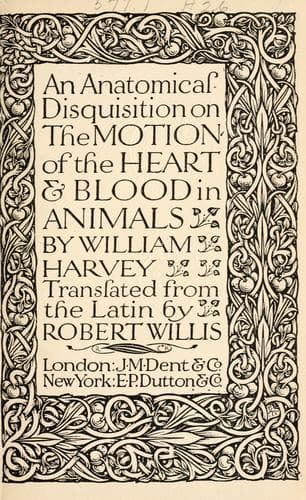
An anatomical disquisition on the motion of the heart & blood in animalsHarvey, William
Science
An anatomical disquisition on the motion of the heart & blood in animals
Harvey, William
Blood -- Circulation
That this is possible, and that there is nothing to prevent it from
being so, appears when we reflect on the way in which water percolating
the earth produces springs and rivulets, or when we speculate on
the means by which the sweat passes through the skin, or the urine
through the parenchyma of the kidneys. It is well known that persons
who use the Spa waters, or those of La Madonna, in the territories of
Padua, or others of an acidulous or vitriolated nature, or who simply
swallow drinks by the gallon, pass all off again within an hour or
two by urine. Such a quantity of liquid must take some short time in
the concoction: it must pass through the liver; (it is allowed by all
that the juices of the food we consume pass twice through this organ
in the course of the day;) it must flow through the veins, through the
parenchyma of the kidneys, and through the ureters into the bladder.
To those, therefore, whom I hear denying that the blood, aye the whole
mass of the blood may pass through the substance of the lungs, even as
the nutritive juices percolate the liver, asserting such a proposition
to be impossible, and by no means to be entertained as credible, I
reply, with the poet, that they are of that race of men who, when they
will, assent full readily, and when they will not, by no manner of
means; who, when their assent is wanted, fear, and when it is not, fear
not to give it.
The parenchyma of the liver is extremely dense, so is that of the
kidney; the lungs, again, are of a much looser texture, and if
compared with the kidneys are absolutely spongy. In the liver there
is no forcing, no impelling power; in the lungs the blood is forced
on by the pulse of the right ventricle, the necessary effect of whose
impulse is the distension of the vessels and pores of the lungs. And
then the lungs, in respiration, are perpetually rising and falling;
motions, the effect of which must needs be to open and shut the pores
and vessels, precisely as in the case of a sponge, and of parts having
a spongy structure, when they are alternately compressed and again are
suffered to expand. The liver, on the contrary, remains at rest, and
is never seen to be dilated and constricted. Lastly, if no one denies
the possibility of the whole of the ingested juices passing through
the liver, in man, oxen, and the larger animals generally, in order
to reach the vena cava, and for this reason, that if nourishment is
to go on, these juices must needs get into the veins, and there is no
other way but the one indicated, why should not the same arguments
be held of avail for the passage of the blood in adults through the
lungs? Why not, with Columbus, that skilful and learned anatomist,
maintain and believe the like, from the capacity and structure of the
pulmonary vessels; from the fact of the pulmonary veins and ventricle
corresponding with them, being always found to contain blood, which
must needs have come from the veins, and by no other passage save
Public-domain text, read in full here on John Shaqi.
Reviews
Reviews
No reviews yet
Be the first to share your thoughts on this work.
Join the Discussion
Join the discussion
Sign in to leave a comment or review.
Sign InorCreate an account