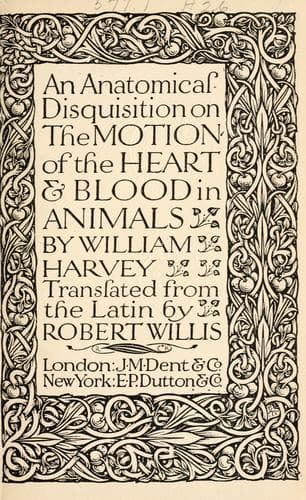
An anatomical disquisition on the motion of the heart & blood in animalsHarvey, William
Science
An anatomical disquisition on the motion of the heart & blood in animals
Harvey, William
Blood -- Circulation
This argument Galen adduces for the transit of the blood by the right
ventricle from the vena cava into the lungs; but we can use it with
still greater propriety, merely changing the terms, for the passage
of the blood from the veins through the heart into the arteries.
From Galen, however, that great man, that father of physicians, it
clearly appears that the blood passes through the lungs from the
pulmonary artery into the minute branches of the pulmonary veins,
urged to this both by the pulses of the heart and by the motions
of the lungs and thorax; that the heart, moreover, is incessantly
receiving and expelling the blood by and from its ventricles, as from
a magazine or cistern, and for this end is furnished with four sets
of valves, two serving for the induction and two for the eduction of
the blood, lest, like the Euripus, it should be incommodiously sent
hither and thither, or flow back into the cavity which it should
have quitted, or quit the part where its presence was required, and
so the heart be oppressed with labour in vain, and the office of the
lungs be interfered with.[29] Finally, our position that the blood is
continually passing from the right to the left ventricle, from the vena
cava into the aorta, through the porous structure of the lungs, plainly
appears from this, that since the blood is incessantly sent from the
right ventricle into the lungs by the pulmonary artery, and in like
manner is incessantly drawn from the lungs into the left ventricle, as
appears from what precedes and the position of the valves, it cannot
do otherwise than pass through continuously. And then, as the blood
is incessantly flowing into the right ventricle of the heart, and is
continually passed out from the left, as appears in like manner, and as
is obvious both to sense and reason, it is impossible that the blood
can do otherwise than pass continually from the vena cava into the
aorta.
[29] See the Commentary of the learned Hofmann upon the Sixth Book of
Galen, “De Usu partium,” a work which I first saw after I had written
what precedes.
Public-domain text, read in full here on John Shaqi.
Reviews
Reviews
No reviews yet
Be the first to share your thoughts on this work.
Join the Discussion
Join the discussion
Sign in to leave a comment or review.
Sign InorCreate an account