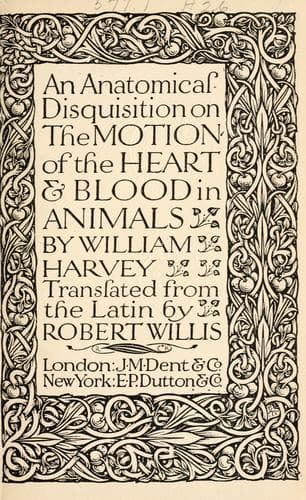
An anatomical disquisition on the motion of the heart & blood in animalsHarvey, William
Science
An anatomical disquisition on the motion of the heart & blood in animals
Harvey, William
Blood -- Circulation
And now the cause is manifest, wherefore in our dissections we usually
find so large a quantity of blood in the veins, so little in the
arteries; wherefore there is much in the right ventricle, little in the
left; circumstances which probably led the ancients to believe that
the arteries (as their name implies) contained nothing but spirits
during the life of an animal. The true cause of the difference is this
perhaps: that as there is no passage to the arteries, save through the
lungs and heart, when an animal has ceased to breathe and the lungs to
move, the blood in the pulmonary artery is prevented from passing into
the pulmonary veins, and from thence into the left ventricle of the
heart; just as we have already seen the same transit prevented in the
embryo, by the want of movement in the lungs and the alternate opening
and shutting of their minute orifices and invisible pores. But the
heart not ceasing to act at the same precise moment as the lungs, but
surviving them and continuing to pulsate for a time, the left ventricle
and arteries go on distributing their blood to the body at large and
sending it into the veins; receiving none from the lungs, however,
they are soon exhausted and left, as it were, empty. But even this
fact confirms our views, in no trifling manner, seeing that it can be
ascribed to no other than the cause we have just assumed.
Moreover it appears from this that the more frequently or forcibly
the arteries pulsate, the more speedily will the body be exhausted in
an hemorrhagy. Hence, also, it happens, that in fainting fits and in
states of alarm, when the heart beats more languidly and with less
force, hemorrhages are diminished or arrested.
Still further, it is from this that after death, when the heart has
ceased to beat, it is impossible by dividing either the jugular or
femoral veins and arteries, by any effort to force out more than one
half of the whole mass of the blood. Neither could the butcher, did he
neglect to cut the throat of the ox which he has knocked on the head
and stunned, until the heart had ceased beating, ever bleed the carcass
effectually.
Finally, we are now in a condition to suspect wherefore it is that no
one has yet said anything to the purpose upon the anastomosis of the
veins and arteries, either as to where or how it is effected, or for
what purpose. I now enter upon the investigation of the subject.
CHAPTER X
THE FIRST POSITION: OF THE QUANTITY OF BLOOD PASSING FROM THE VEINS
TO THE ARTERIES. AND THAT THERE IS A CIRCUIT OF THE BLOOD, FREED FROM
OBJECTIONS, AND FARTHER CONFIRMED BY EXPERIMENT
So far our first position is confirmed, whether the thing be referred
to calculation or to experiment and dissection, viz. that the blood
is incessantly infused into the arteries in larger quantities than it
can be supplied by the food; so that the whole passing over in a short
space of time, it is matter of necessity that the blood perform a
circuit, that it return to whence it set out.
Public-domain text, read in full here on John Shaqi.
Reviews
Reviews
No reviews yet
Be the first to share your thoughts on this work.
Elsewhere in the archive
Join the Discussion
Join the discussion
Sign in to leave a comment or review.
Sign InorCreate an account