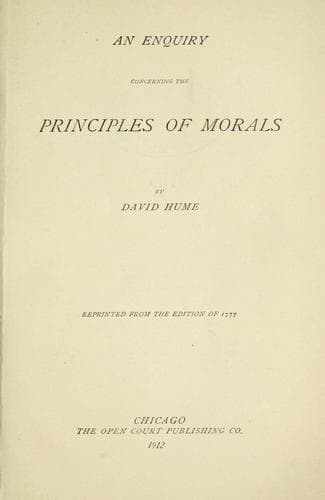
An Enquiry Concerning the Principles of MoralsHume, David
PhilosophyPhilosophy
An Enquiry Concerning the Principles of Morals
Hume, David
Conduct of life; Ethics
But if, instead of this fancied monster, we suppose a MAN to form
a judgement or determination in the case, there is to him a plain
foundation of preference, where everything else is equal; and however
cool his choice may be, if his heart be selfish, or if the persons
interested be remote from him; there must still be a choice or
distinction between what is useful, and what is pernicious. Now this
distinction is the same in all its parts, with the MORAL DISTINCTION,
whose foundation has been so often, and so much in vain, enquired after.
The same endowments of the mind, in every circumstance, are agreeable
to the sentiment of morals and to that of humanity; the same temper is
susceptible of high degrees of the one sentiment and of the other;
and the same alteration in the objects, by their nearer approach or
by connexions, enlivens the one and the other. By all the rules of
philosophy, therefore, we must conclude, that these sentiments are
originally the same; since, in each particular, even the most minute,
they are governed by the same laws, and are moved by the same objects.
Why do philosophers infer, with the greatest certainty, that the moon is
kept in its orbit by the same force of gravity, that makes bodies fall
near the surface of the earth, but because these effects are, upon
computation, found similar and equal? And must not this argument bring
as strong conviction, in moral as in natural disquisitions?
To prove, by any long detail, that all the qualities, useful to
the possessor, are approved of, and the contrary censured, would be
superfluous. The least reflection on what is every day experienced in
life, will be sufficient. We shall only mention a few instances, in
order to remove, if possible, all doubt and hesitation.
The quality, the most necessary for the execution of any useful
enterprise, is discretion; by which we carry on a safe intercourse with
others, give due attention to our own and to their character, weigh each
circumstance of the business which we undertake, and employ the
surest and safest means for the attainment of any end or purpose. To a
Cromwell, perhaps, or a De Retz, discretion may appear an alderman-like
virtue, as Dr. Swift calls it; and being incompatible with those vast
designs, to which their courage and ambition prompted them, it might
really, in them, be a fault or imperfection. But in the conduct of
ordinary life, no virtue is more requisite, not only to obtain success,
but to avoid the most fatal miscarriages and disappointments. The
greatest parts without it, as observed by an elegant writer, may be
fatal to their owner; as Polyphemus, deprived of his eye, was only the
more exposed, on account of his enormous strength and stature.
Public-domain text, read in full here on John Shaqi.
Reviews
Reviews
No reviews yet
Be the first to share your thoughts on this work.
Join the Discussion
Join the discussion
Sign in to leave a comment or review.
Sign InorCreate an account