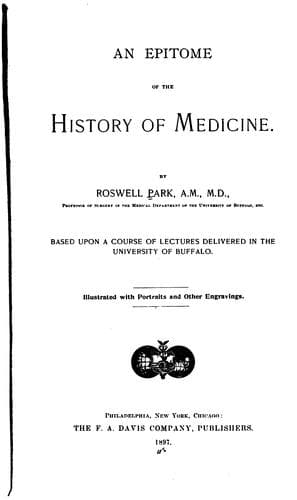
An Epitome of the History of MedicinePark, Roswell
History
An Epitome of the History of Medicine
Park, Roswell
Medicine -- History
A celebrated disciple of Asclepiades was _Themison_, of Laodicea
(b.c. 50), who was led by the teachings of his master to{045} lay the
foundation of the so-called _Methodism_ as opposed to _Dogmatism_ in the
school of Cos. By him and his followers a very arbitrary arrangement of
diseases was made, according to what they considered the constrictive,
or contractive; the fluxionary,--congested or relaxed; and the mixed
forms. From this division of diseases it appears that, according to
the methodists, there were only two kinds of therapeutic indications
to follow,--namely, to relax where there was constriction, to constrict
where there was relaxation. They, however, admitted a third creditable
result, which they called prophylactic; but the pure methodists, such
as Ccelius Aurelianus, admitted neither specific disease nor specific
remedies, and erased from their materia medica purgatives, diuretics,
emmenagogues, nauseants, etc.
According to the methodist doctrine, the study of medicine was so
abridged that one of its prominent exponents said that he felt able
to teach the whole of medical science in six months. It made rapid
progress, and consequently was most attractive to the numerous young
neophytes who were anxious to finish their apprenticeship and hasten
into practice. It is not one of the smallest of the services which Galen
rendered to his time and to posterity that he demolished the sophistry
of the methodists, demonstrated the insufficiency of their practice, and
brought to bear upon them the wittiest satire, calling them the asses
of Thessaly, alluding thereby to their lack of literature and medical
instruction.
In summing up, then, the basis for the various systems of medicine
during this period of antiquity, it is seen that the most ancient
doctrine of all--_Dogmatism_--directs our attention especially to the
animal economy in health and disease; that it took account of the union
of vital forces, of sympathies in the organism, and of nature's efforts
to repel both internal and external deleterious influences, which{046}
providential tendency manifests itself especially in certain acute
diseases. This was the strong side of dogmatism. Its weak side consisted
in this: that it was held that the causes of diseases inhere in the
access of certain qualities and humors along with organic forces,--such
as dryness or moisture in combination with bile or atrabile,--and the
treatment was directed against these supposed causes. It was on account
of this weakness that the enemies of dogmatism attacked it. The empirics
opposed the idea that inaccessible and occult causes of disease could
become the basis for rational treatment. They affirmed that there was no
consistent relation of antagonism or similitude between the disease and
the remedies which cured it.
Public-domain text, read in full here on John Shaqi.
Reviews
Reviews
No reviews yet
Be the first to share your thoughts on this work.
Join the Discussion
Join the discussion
Sign in to leave a comment or review.
Sign InorCreate an account