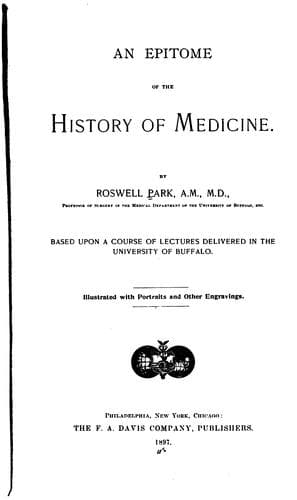
An Epitome of the History of Medicine — John Shaqi
An Epitome of the History of MedicinePark, Roswell
History
An Epitome of the History of Medicine
Park, Roswell
Medicine -- History
This doctrine had been proclaimed for about a century during the period
of which we now speak, but later led men into a fondness for secondary
generalities or for the elevation and magnifying of trifles, which
confused their minds and terminated its usefulness to science.
Meanwhile, a man of great intelligence, renowned as an
elocutionist, well{044} versed in the doctrine of philosophers and
grammarians--namely, _Asclepiades_, of Bythinia--came to Rome with the
intention of teaching rhetoric. By his talent and personal address he
soon became one of the most illustrious persons in the Roman Republic;
so early as 150 B.C. he enjoyed a high reputation as a rhetorician, and
was one of the intimate friends of Cicero; nevertheless, he abandoned
letters, undertook the practice of medicine, and sought moreover to
create a new system, being unwilling to follow in the track of his
predecessors. Imbued with the philosophy of Epicurus, who was then in
high repute, he deduced from it a theory which was in harmony with the
philosophy of the day. He thought that the elements of the body existed
from eternity; that they were indivisible, impalpable, and perceptible
to the reason only. These elements he named _atoms_, which were supposed
to be animated by perpetual motion, and from which, by their frequent
encounters and fortuitous contention, all sensible phenomena were
supposed to result. He explained the properties of the body by saying
that compounds were aggregates of atoms, differing very much from atoms
themselves. Solid silver, he said, is white, but, reduced to powder,
appears black; the horn of the goat, on the contrary, is black, but
if it be razed its particles are white. This, it will be seen, was
the parent of our present atomic theory. He ridiculed the theories of
Hippocrates concerning coction, crises, etc., and sarcastically called
the Hippocratic treatise on therapeutics "a meditation on death."
Asclepiades based his own therapeutics on endeavors so to enlarge
the pores of the human body that disease could find egress, or so to
constrict them that it could not enter; consequently he rejected
all violent remedies, such as vomits, purges, etc., and his favorite
remedies were hygienic,--for the most part bodily exercise.
Public-domain text, read in full here on John Shaqi.
Reviews
Reviews
No reviews yet
Be the first to share your thoughts on this work.
Join the Discussion
Join the discussion
Sign in to leave a comment or review.
Sign InorCreate an account