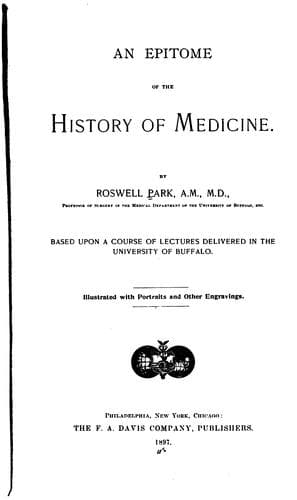
An Epitome of the History of MedicinePark, Roswell
History
An Epitome of the History of Medicine
Park, Roswell
Medicine -- History
Of all the Moslem rulers, the most distinguished for love of learning
and general enlightenment was Haroun-al-Raschid, the Charlemagne of
the East, contemporary and emulator of the glory of the emperor of the
Franks, the hero of a hundred Arabic poems, whose dominion extended
from the borders of the Indus to the heart of the Spanish peninsula.
He embellished Bagdad, his capital, with schools and hospitals. His son
Almamon founded the Academy of Bagdad, which became the most celebrated
of the age; likewise spared no pains to draw to his court the most
illustrious men of all countries. He enjoined each of his ambassadors to
purchase all the writings of the philosophers and physicians that
could be found, and these he required to be translated into Arabic; his
interpreter, Honain, a Christian, was employed at translating for
forty-five{059} years, and received, for each book rendered into Arabic,
literally its weight in gold.
The eclat which the Moorish caliphs shed upon Spain from the tenth to
the thirteenth century is well known. The cities of Cordova, Toledo,
Seville, and Murcia possessed public libraries and academies, and
students from all parts of Europe flocked to them to be instructed in
arts and sciences; the library of Cordova alone embraced more than two
hundred and twenty-four thousand volumes. Thus it will be seen that
the dominion of mental and temporal affairs passed from the Greeks and
Romans to the Saracens.
Arabian medicine constitutes one of the most interesting chapters in the
history of our art. An offspring from Greek schools, it was for nearly
one hundred years the fostermother of that art, and, although it gave
rise to no great discovery nor wonderful step in advance during all this
period, it nevertheless kept alive all the learning of the past,
and clarified rather than made it turbid. In the sixth century the
Nestorians (followers of Bishop Nestor), having been driven out of
Syria, settled in Persia, Mesopotamia, and Arabia, and there founded
schools and other institutions such as they had had at home,--schools
in which, beside the ordinary philosophic studies, medicine received
a share of attention. Thus it came about that by the seventh century
Arabian physicians were everywhere known and in high repute. Naturally
the basis for their studies embodied the writings of Hippocrates, Galen,
Oribasius, and Paul of Ægina; and the first Arabian works consisted
solely of translations from the Greek, first out of their Syriac
rendering, and later from the originals. Indeed, so much eminence was
finally achieved by Arabian physicians that more than four hundred are
known by name as authors.
The first author deserving of mention was _Bachtischua_, of Nestorian
stock, celebrated in Jondisapur, director of the medical school, and
later physician to Caliph El-Mansur, in Bagdad.{060} Of his descendants
several became well known in the same field.
Public-domain text, read in full here on John Shaqi.
Reviews
Reviews
No reviews yet
Be the first to share your thoughts on this work.
Elsewhere in the archive
Join the Discussion
Join the discussion
Sign in to leave a comment or review.
Sign InorCreate an account