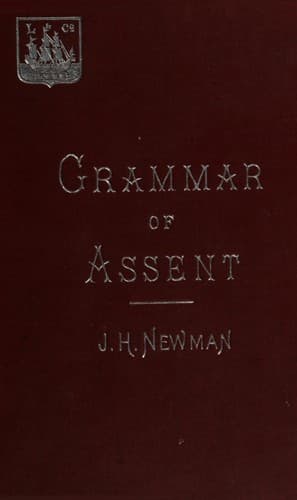
An Essay in Aid of a Grammar of AssentNewman, John Henry
Religion
An Essay in Aid of a Grammar of Assent
Newman, John Henry
Faith; Theism
There are philosophers who go farther, and teach, not only a general,
but an invariable, and inviolable, and necessary uniformity in the
action of the laws of nature, holding that every thing is the result
of some law or laws, and that exceptions are impossible; but I do
not see on what ground of experience or reason they take up this
position. Our experience rather is adverse to such a doctrine, for
what concrete fact or phenomenon exactly repeats itself? Some abstract
conception of it, more perfect than the recurrent phenomenon itself,
is necessary, before we are able to say that it has happened even
twice, and the variations which accompany the repetition are of the
nature of exceptions. The earth, for instance, never moves exactly in
the same orbit year by year, but is in perpetual vacillation. It will,
indeed, be replied that this arises from the interaction of one law
with another, of which the actual orbit is only the accidental issue,
that the earth is under the influence of a variety of attractions from
cosmical bodies, and that, if it is subject to continual aberrations
in its course, these are accounted for accurately or sufficiently by
the presence of those extraordinary and variable attractions:—science,
then, by its analytical processes sets right the _primâ facie_
confusion. Of course; still let us not by our words imply that we are
appealing to experience, when really we are only accounting, and that
by hypothesis, for the absence of experience. The confusion is a fact,
the reasoning processes are not facts. The extraordinary attractions
assigned to account for our experience of that confusion are not
themselves experienced phenomenal facts, but more or less probable
hypotheses, argued out by means of an assumed analogy between the
cosmical bodies to which those attractions are referred and falling
bodies on the earth. I say “assumed,” because that analogy (in other
words, the unfailing uniformity of nature) is the very point which
has to be proved. It is true, that we can make experiment of the law
of attraction in the case of bodies on the earth; but, I repeat, to
assume from analogy that, as stones do fall to the earth, so Jupiter,
if let alone, would fall upon the earth and the earth upon Jupiter,
and with certain peculiarities of velocity on either side, is to have
recourse to an explanation which is not necessarily valid, unless
nature is necessarily uniform. Nor, indeed, has it yet been proved,
nor ought it to be assumed, even that the law of velocity of falling
bodies on the earth is invariable in its operation; for that again is
only an instance of the general proposition, which is the very thesis
in debate. It seems safer then to hold that the order of nature is not
necessary, but general in its manifestations.
Public-domain text, read in full here on John Shaqi.
Reviews
Reviews
No reviews yet
Be the first to share your thoughts on this work.
Join the Discussion
Join the discussion
Sign in to leave a comment or review.
Sign InorCreate an account