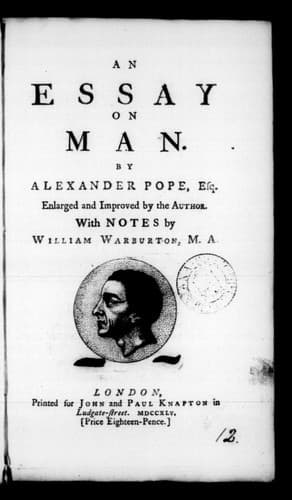
An Essay on Man; Moral Essays and SatiresPope, Alexander
ReligionComparative
An Essay on Man; Moral Essays and Satires
Pope, Alexander
English poetry -- 18th century
Where'er he shines, O Fortune, gild the scene,
And angels guard him in the golden mean!
There, English bounty yet awhile may stand,
And Honour linger ere it leaves the land.
But all our praises why should lords engross?
Rise, honest Muse! and sing the Man of Ross:
Pleased Vaga echoes through her winding bounds,
And rapid Severn hoarse applause resounds.
Who hung with woods you mountain's sultry brow?
From the dry rock who bade the waters flow?
Not to the skies in useless columns tost,
Or in proud falls magnificently lost,
But clear and artless, pouring through the plain
Health to the sick, and solace to the swain.
Whose causeway parts the vale with shady rows?
Whose seats the weary traveller repose?
Who taught that heaven-directed spire to rise?
"The Man of Ross," each lisping babe replies.
Behold the market-place with poor o'erspread!
The Man of Ross divides the weekly bread;
He feeds yon almshouse, neat, but void of state,
Where age and want sit smiling at the gate;
Him portioned maids, apprenticed orphans blest,
The young who labour, and the old who rest.
Is any sick? the Man of Ross relieves,
Prescribes, attends, the medicine makes, and gives.
Is there a variance? enter but his door,
Baulked are the courts, and contest is no more.
Despairing quacks with curses fled the place,
And vile attorneys, now a useless race.
B. Thrice happy man! enabled to pursue
What all so wish, but want the power to do!
Oh say, what sums that generous hand supply?
What mines, to swell that boundless charity?
P. Of debts, and taxes, wife and children clear,
This man possest--five hundred pounds a year.
Blush, grandeur, blush! proud courts, withdraw your blaze!
Ye little stars, hide your diminished rays!
B. And what? no monument, inscription, stone?
His race, his form, his name almost unknown?
P. Who builds a church to God, and not to Fame,
Will never mark the marble with his name;
Go, search it there, where to be born and die,
Of rich and poor makes all the history;
Enough, that virtue filled the space between;
Proved, by the ends of being, to have been.
When Hopkins dies, a thousand lights attend
The wretch, who living saved a candle's end:
Shouldering God's altar a vile image stands,
Belies his features, nay, extends his hands;
That livelong wig, which Gorgon's self might own,
Eternal buckle takes in Parian stone.
Behold what blessings wealth to life can lend!
And see what comfort it affords our end.
In the worst inn's worst room, with mat half-hung,
The floors of plaster, and the walls of dung,
On once a flock-bed, but repaired with straw,
With tape-tied curtains, never meant to draw,
The George and Garter dangling from that bed
Where tawdry yellow strove with dirty red,
Great Villiers lies--alas! how changed from him,
That life of pleasure, and that soul of whim!--
Gallant and gay, in Cliveden's proud alcove,
The bower of wanton Shrewsbury and love;
Or just as gay, at council, in a ring
Of mimic'd statesmen and their merry king.
Public-domain text, read in full here on John Shaqi.
Reviews
Reviews
No reviews yet
Be the first to share your thoughts on this work.
Join the Discussion
Join the discussion
Sign in to leave a comment or review.
Sign InorCreate an account